

FAQ
Frequently Asked Questions
Have questions? We have answers
Get a Free PlanHow do you integrate KPIs with ERP, CRM and BI systems?
Connections are made through ready-made connectors to common ERP and CRM systems. Data reaches the KPI system automatically, and if the company already runs Power BI, the dashboards integrate without losing existing work.
Can Moodle be integrated with the institution’s internal systems?
Yes. Integration is done through the platform's REST API, webhooks or a middleware service. The most common scenarios are single sign-on through a corporate account (Active Directory, LDAP, SSO) and synchronising users and the structure of units from the HR system.
SCORM, xAPI and LTI cover external learning content. The exact list of integrations is defined during requirements analysis, depending on the systems the institution already runs.
How do KPIs differ from OKRs?
KPIs are measurable indicators of current performance, while OKRs are a method for setting ambitious goals with key results. The two are not mutually exclusive: OKRs often rest on the same data as a KPI system.
Can existing courses and materials be migrated to Moodle?
Yes. Courses, learning materials, the user base and completion history are all migrated. Where materials currently exist as documents, presentations and video, they are assembled into structured courses; where they sit in another LMS, export in standard formats is used.
Migration is run as a managed project: first a test transfer on a copy, then a data reconciliation, and only after that the launch in production. A rollback plan is prepared in advance.
What learning reports can Moodle produce?
Out of the box you get reports on course progress and completion, assessment results, user activity, the gradebook and action logs. They can be filtered by unit, group, course and period, and exported to a file.
Where the institution needs a report format the core does not provide, we develop a custom one — for example a summary of mandatory programme completion broken down by regional unit.
Does IWIS provide Moodle technical support after launch?
Yes. Moodle support runs under an SLA and covers core and plugin updates including security patches, performance monitoring, incident response and consultations for the institution's administrators.
Platform development is handled separately: new courses and units, additional integrations and reports. The corporate training system we modernised for a leading Ukrainian bank, for example, stayed under our support after launch.
What is an AI solution for business?
An AI solution for business is a system that learns from a company's data and takes on a decision or an action that previously required a person: forecasting demand, scoring the risk of customer churn, classifying requests, choosing a recommendation, finding an answer inside corporate documents.
Artificial intelligence for business differs from ordinary automation in that it works from a pattern derived from historical data rather than from a rule written out in advance.
Which business processes can be automated with AI?
AI automation pays off fastest on repetitive operations that do not reduce to a simple rule: processing and checking documents, classifying and routing requests, preparing and normalising data, drafting routine texts.
Where a process is described by clear conditions, classic business process automation is cheaper and more reliable. We separate the two layers: AI takes on exactly the step that requires "understanding" a text, a document or a behaviour.
How can AI be used for data analysis?
AI data analytics applies where the volume of information exceeds what can be reviewed by hand: finding patterns in transactions, behavioural clustering of the customer base, anomaly detection, testing business hypotheses against historical data.
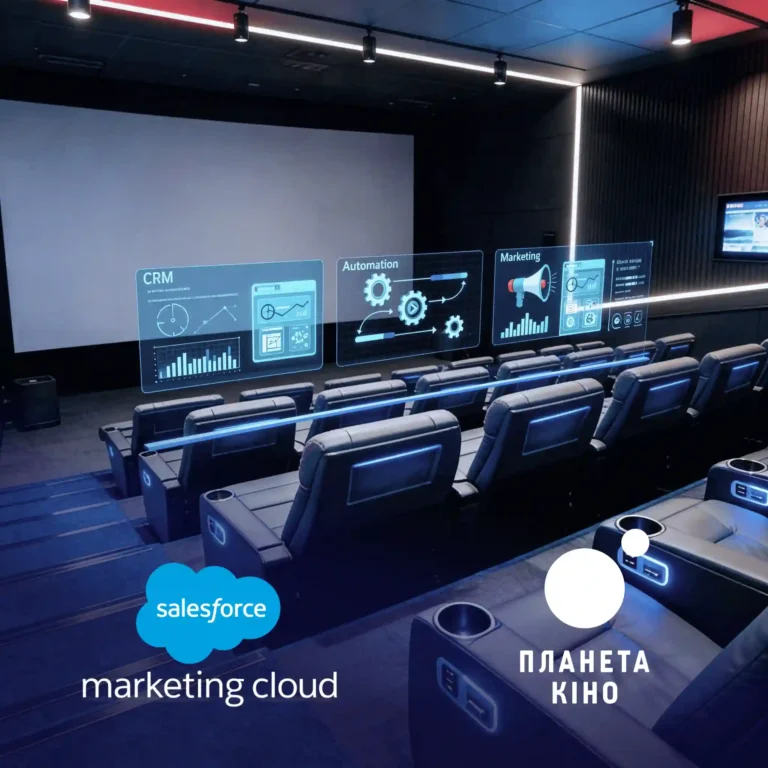
On the Planeta Kino project, ML algorithms broke the base into behavioural clusters using more than a year of transactions, and the results were validated together with the marketing team through in-depth interviews.
What is predictive analytics and how does it help a business?
Predictive analytics forecasts future events from historical data: demand, sales, capacity, stock, the probability of customer churn. Unlike ordinary reporting, which describes the past, forecasting analytics buys you time to act.
A practical example: for New Products Group an ensemble ML model forecasts production volumes with over 80% accuracy. The company moved from reacting to shortages or surpluses after the fact to planning volumes in advance.
Can AI be integrated with CRM, ERP and other systems?
Yes, and this is what makes a solution work in practice. AI integration runs through REST API, message queues, webhooks or a direct connection to the data warehouse — whichever suits your infrastructure.
An example from our work: at Planeta Kino the churn risk score is passed to Salesforce Marketing Cloud, and the customer receives a message matched to their risk level. Forecasts can reach an ERP for production planning or BI reporting in the same way.
Can you build a custom AI solution for our business?
Yes — developing AI solutions around a company's specific processes is our main format of work. Custom AI solutions are needed when an off-the-shelf service does not account for the specifics of the business.
A telling case is goodwine: the client planned to use a ready-made recommendation service, but testing showed the model did not take warehouse stock into account. Our own model, combining behavioural and logistics factors, delivered +5% average order value and +10% stock rotation.
What data is needed to implement AI?
You need a history of the events you want to forecast or classify: transactions, requests, orders, production figures, user behaviour. What matters is not only volume but also the depth of the period and how completely events were recorded.
The state of the data almost always turns out to be a task of its own. In the New Products Group case some retail outlets did not record zero stock, so the system confused an absence of sales with an absence of demand — approximation methods corrected that distortion and materially improved the forecast. This is why we start an AI rollout with a data audit rather than with choosing a model.
How long does it take to build and implement an AI solution?
The timeline depends on the state of the data and on how many systems the integration touches. For reference, the real durations of our projects: the churn prediction model for Edenred took five months, the analytics and churn model for Planeta Kino eight months, and production forecasting for New Products Group and the recommendation system for goodwine twelve months each including rollout.
Testing a hypothesis on a PoC is usually much faster. We give a precise estimate after the data audit and once the scope of the first phase is agreed.
Can we start with an MVP or a proof of concept?
Yes, and for most tasks that is the most sensible start. A PoC checks one thing: whether the data holds a signal strong enough for the accuracy you need. That turns the decision about further investment into a matter of fact rather than expectation.
We apply this approach systematically. The first version of the model for New Products Group was built on a limited set of features while the tender was still running and, despite its simplicity, delivered the highest accuracy of all participants. The full ensemble model was developed only after the hypothesis was confirmed.
Can an AI solution be scaled after launch?
Yes. After launch a model needs support: forecast quality is monitored and the model itself is retrained on new data, because customer behaviour and the market change.
Scaling usually goes one of two ways: extending to adjacent tasks and categories — at New Products Group the first model became the foundation for other product lines — or connecting new channels and systems, as at Planeta Kino, where recommendations run simultaneously in push, email and the mobile app.




IWIS development principles