

AI Analytics and AI Solutions for Business
We build and implement custom AI solutions for specific business tasks: data analytics, forecasting, process automation, machine learning and artificial intelligence integrated into your systems
Discuss an AI projectAI solutions built around your business tasks
IWIS builds and implements AI solutions for business — not a catalogue of ready-made products, but systems shaped by one company’s processes, data and goals. We treat AI for business as a tool for a specific task, which is why artificial intelligence solutions are designed around your data rather than the other way round. The practice covers AI data analytics, predictive and forecasting analytics, AI automation of business processes, machine learning, generative AI, AI agents and assistants, and AI integration with CRM, ERP and corporate data warehouses.
Artificial intelligence for business starts not with picking a model but with the task and the state of the data. Every project therefore begins with analysis: what data already exists, how usable it is for training, and exactly which decision it should inform. Then comes the concept, a PoC or MVP, and only after that a production AI rollout. We take artificial intelligence technologies all the way to a working tool that lives inside your systems rather than beside them.
We do not take on AI where the task is cheaper to solve with business process automation or properly built business analytics.

Decisions from data, not intuition
AI for data analysis processes volumes no one can review by hand: it finds patterns, dependencies and anomalies that pivot tables never show.

A forecast instead of reacting after the fact
Predictive analytics shows demand, sales, risks and stock ahead of time. On the project for New Products Group an ensemble ML model reached over 80% accuracy in production forecasting.

Less manual work
AI automation takes repetitive operations off the team: document processing, request classification, reconciliation and data preparation.

Personalisation that moves revenue
Recommendation models pick the relevant product or piece of content. For goodwine our own model lifted the average order value by 5% and stock rotation by 10%.

Customer retention
Churn models flag the risk before a customer leaves: at Planeta Kino churn fell from 13% to 7%, and at Edenred the model spots B2B contracts at risk early.

Scaling without hiring in proportion
Artificial intelligence in business lets you absorb growth in requests, orders and data without expanding the team at the same rate.
When to start
5 signs a business already needs AI solutions
Artificial intelligence in business makes sense not when a budget for experiments appears, but when the volume of data and routine work has outgrown what people can handle by hand.
Real AI and ML projects by IWIS
New Products Group — production forecasting

Planeta Kino — customer churn prediction

Edenred — retaining B2B contracts
goodwine — personalised recommendations
What we can build with AI
AI for business is not one product but a set of directions. We work both on single AI tasks inside existing systems and on solutions built from scratch; the scope always starts from the data and processes a company already has.
AI analytics and data analysis
AI analytics works where classic reporting no longer answers the question: there is too much data, the links between figures are not obvious, and testing a hypothesis by hand takes weeks.
- Finding patterns and dependencies across large volumes of transactions, requests and logs.
- Segmentation and behavioural clustering of the customer base.
- Anomaly detection: unusual operations, data faults, deviations from the normal process.
- AI data analytics as a layer on top of an existing warehouse or BI system.
Predictive and forecasting analytics
Predictive analytics answers not “what happened” but “what will happen”. It is the direction we have proven on real projects most often.
- AI for forecasting demand and production volumes — as in the ensemble model for New Products Group.
- Sales and capacity forecasts by period, location and product category.
- Forecasting analytics for stock: how much to produce or order, and when.
- Customer churn models for B2C and B2B — an early risk signal instead of reacting after the fact.
- Forecasts for the key metrics from your KPI system.
AI automation of business processes
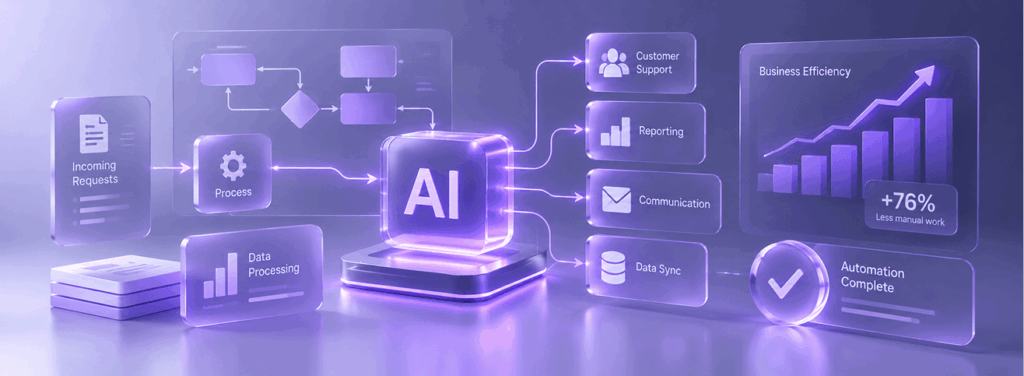
AI for business process automation applies where an operation is repetitive but does not reduce to a rigid rule: something has to be “understood” — a text, a document or a behaviour — before a decision is made.
- Document processing: recognition, field extraction, completeness checks.
- Classifying and routing requests and applications by topic and priority.
- Business automation with AI alongside your existing process automation.
- Data preparation and normalisation, control of duplicates and contradictions.
Machine learning on your data
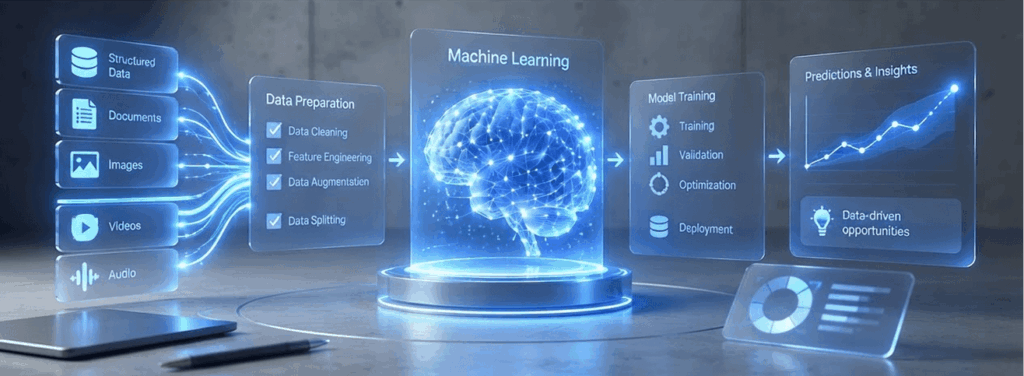
Machine learning and artificial intelligence are not about buying a finished model but about training one on your data. Developing artificial intelligence for a specific company starts exactly here: whether the solution reaches production depends on which features go into the model.
- Feature engineering together with your business experts: on the Edenred and New Products Group projects this was a series of workshops with the client team.
- Testing several ML architectures and choosing the model by business metric, not accuracy alone.
- Working around data defects: at New Products Group, approximating unrecorded zero stock materially improved the forecast.
- Recommendation and ranking models, model ensembles.
- A data pipeline and model retraining on new data after launch.
Generative AI for text and knowledge work
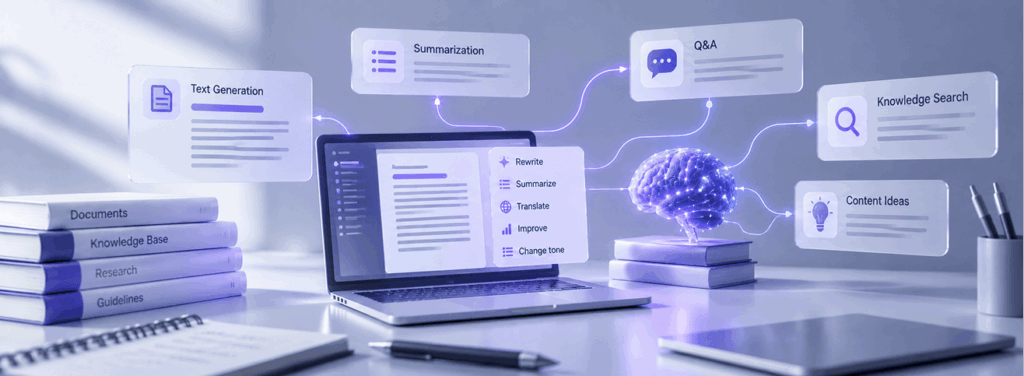
Generative artificial intelligence covers tasks involving natural language and unstructured content: documents, requests and a company’s internal knowledge.
- AI search across a knowledge base: a question in plain language returns an answer with a link to the source, not a list of files.
- Processing and summarising documents, contracts, requests and reviews.
- Drafting replies and routine texts in the company tone of voice.
- Deployment inside the company perimeter when data cannot leave it.
AI agents and AI assistants
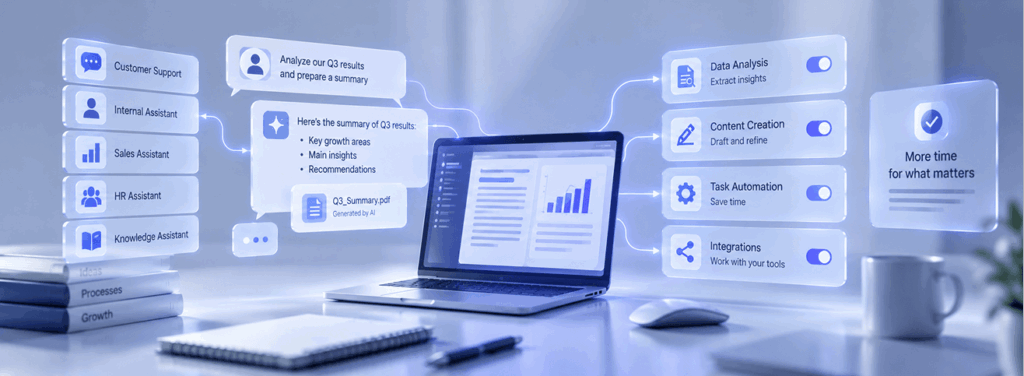
AI agents carry out multi-step tasks: find the data, reconcile it, prepare a document, pass it on or call in a person. AI assistants work in dialogue with the user.
- Text and voice assistants in the product, on the website or inside a corporate system.
- An AI consultant that helps a user frame the request and reach a decision.
- We go through the practical scenarios in our article on AI solutions for customer communication.
- Connections to CRM, LMS and databases instead of an isolated chat, with a human checkpoint wherever the cost of a mistake is high.
AI integration into your IT infrastructure
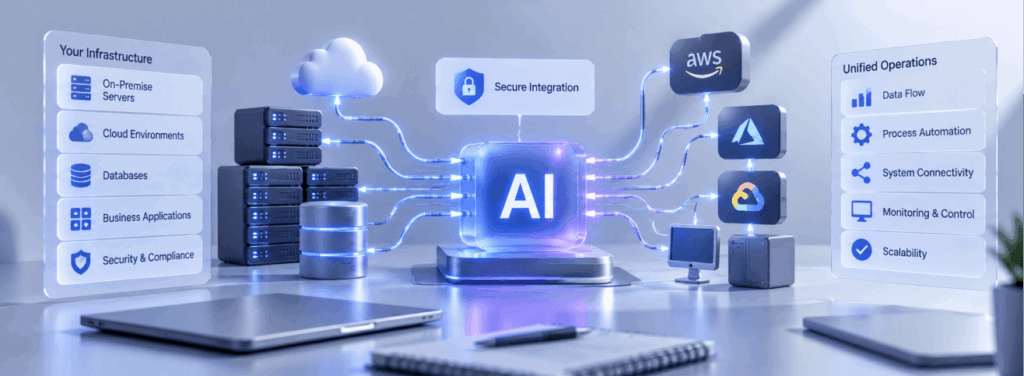
A model is only useful when its output reaches the place where the decision is made. AI integration is therefore as much a part of the project as training the model.
- AI integration with CRM: at Planeta Kino the churn risk score is passed to Salesforce Marketing Cloud and drives the communication.
- AI integration with ERP and accounting systems: forecasts feed production and procurement planning.
- AI integration with corporate systems through REST API, message queues and webhooks.
- Connections to a DWH and BI reporting — the model runs on the same data as management analytics.
- An artificial intelligence rollout that respects GDPR: for Edenred, client data was anonymised before processing outside the EU.
Stages of an AI rollout: from the task to a working model
Implementing artificial intelligence starts not with choosing a model but with the business task and the state of the data. That order makes it possible to stop early if AI would offer no advantage over a simpler solution in this particular case.
Task analysis and data audit
We work out which decision AI is meant to improve and which metric will measure the result. Hypotheses are formed together with your business experts — on the Edenred and New Products Group projects this was a series of working workshops. In parallel we look at what data exists, where it comes from and what state it is in: this is where the gaps, duplicates and unrecorded events that later affect accuracy come to light. If the data is not sufficient, we say so and suggest what to collect first.
Solution concept
We fix the architecture: which features we use, which type of model we test and how the result will reach the business process. This is also where the scope of the first phase and the data protection requirements are agreed.
PoC or MVP
We build a prototype on real data and test the hypothesis before any large investment. The first version of the model for New Products Group was built on a limited set of features while the tender was still running — and delivered the highest accuracy of all participants.
Model development and training
We engineer the features, test several ML architectures and compare them by business metric rather than accuracy alone. In parallel we build the data pipeline so the model receives fresh data automatically instead of through manual exports.
Integration, launch and growth
We connect the model output to the systems where it is actually used: CRM, ERP, a mobile app or BI reporting. We check behaviour under load, access rights and data correctness, then move the solution into production. After launch we monitor forecast quality, retrain the model on new data and extend it to adjacent tasks — at New Products Group the first model became the foundation for scaling to other product categories.
AI solutions for different areas of business
AI for sales
Sales forecasting, scoring leads and customers by churn risk, choosing the next best offer. Signals from the model return to the CRM, so a manager sees them in the familiar interface rather than in a separate report.
AI for e-commerce
Personalised catalogue recommendations, similar products and cross-sell that account for real warehouse stock — this is how the model for goodwine was built. Personalised email and push communication belongs here too.
AI for logistics and manufacturing
Forecasting demand and production volumes, planning stock, reducing the risk of overproduction and shortages. A practical example is the ensemble model for New Products Group with over 80% accuracy.
AI for process optimisation
Automatic document processing, request classification, data validation and normalisation. This suits companies where a large share of working time goes on repetitive operations with text and files.
AI chatbot for business
Text and voice assistants, AI search across an internal knowledge base, guiding a user through the product. Unlike a boxed chatbot, a custom assistant connects to the company’s CRM, LMS and databases.
AI agents
Autonomous or semi-autonomous execution of multi-step tasks: gather data, reconcile it, prepare a document, pass it on or call in a person at the point where the cost of a mistake is high.
Frequently asked questions about AI solutions for business
What is an AI solution for business?
An AI solution for business is a system that learns from a company's data and takes on a decision or an action that previously required a person: forecasting demand, scoring the risk of customer churn, classifying requests, choosing a recommendation, finding an answer inside corporate documents.
Artificial intelligence for business differs from ordinary automation in that it works from a pattern derived from historical data rather than from a rule written out in advance.
Which business processes can be automated with AI?
AI automation pays off fastest on repetitive operations that do not reduce to a simple rule: processing and checking documents, classifying and routing requests, preparing and normalising data, drafting routine texts.
Where a process is described by clear conditions, classic business process automation is cheaper and more reliable. We separate the two layers: AI takes on exactly the step that requires "understanding" a text, a document or a behaviour.
How can AI be used for data analysis?
AI data analytics applies where the volume of information exceeds what can be reviewed by hand: finding patterns in transactions, behavioural clustering of the customer base, anomaly detection, testing business hypotheses against historical data.
On the Planeta Kino project, ML algorithms broke the base into behavioural clusters using more than a year of transactions, and the results were validated together with the marketing team through in-depth interviews.
What is predictive analytics and how does it help a business?
Predictive analytics forecasts future events from historical data: demand, sales, capacity, stock, the probability of customer churn. Unlike ordinary reporting, which describes the past, forecasting analytics buys you time to act.
A practical example: for New Products Group an ensemble ML model forecasts production volumes with over 80% accuracy. The company moved from reacting to shortages or surpluses after the fact to planning volumes in advance.
Can AI be integrated with CRM, ERP and other systems?
Yes, and this is what makes a solution work in practice. AI integration runs through REST API, message queues, webhooks or a direct connection to the data warehouse — whichever suits your infrastructure.
An example from our work: at Planeta Kino the churn risk score is passed to Salesforce Marketing Cloud, and the customer receives a message matched to their risk level. Forecasts can reach an ERP for production planning or BI reporting in the same way.
Can you build a custom AI solution for our business?
Yes — developing AI solutions around a company's specific processes is our main format of work. Custom AI solutions are needed when an off-the-shelf service does not account for the specifics of the business.
A telling case is goodwine: the client planned to use a ready-made recommendation service, but testing showed the model did not take warehouse stock into account. Our own model, combining behavioural and logistics factors, delivered +5% average order value and +10% stock rotation.