


Moodle LMS Development and Implementation for Business
We design, configure and integrate the Moodle learning platform around the way your company actually works — from employee onboarding to training your partner network
Discuss your projectWhat Moodle LMS development gives a business
Moodle is the most widely used open-source learning management system in the world. In short, an LMS is one environment where courses, tests, user roles and completion reporting live together, instead of being spread across shared folders and email threads with HR.
Because Moodle is best known from universities, businesses often read it as an education-only product. In reality the Moodle learning platform is a flexible GPL-licensed framework, not an online course tool with a fixed feature list: a Moodle distance learning platform covers onboarding, mandatory information security courses, recertification and dealer training equally well.
IWIS does not treat Moodle as an out-of-the-box product but as a platform to be shaped around one specific company: learning platform development for your scenarios, Moodle configuration, customization, custom modules, integration with your corporate systems and support after launch.

The platform is yours, not the vendor
Moodle is distributed under the GPL: no per-user fees and no course limits. It is deployed inside your own infrastructure, and your training data stays under your control.

Customization instead of compromises
The interface, roles, permissions and report formats are configured around your processes. Where the standard feature set falls short, we do custom Moodle development — our own modules and plugins.

Single sign-on with a corporate account
Integration with Active Directory, LDAP or SSO removes separate logins and manual user management: an employee signs in to the learning platform with the corporate account they already have.

Corporate training on autopilot
A corporate learning system assigns courses by job title or department on its own, chases deadlines and produces reports instead of manual exports into Excel.

Scaling without a rewrite
Moodle LMS handles large user counts and deep organizational structures. A new training area is added as configuration, not as a separate project.

Real visibility into progress
A corporate learning platform shows who completed a course, who is stuck and at which step. A team lead sees their own team, HR sees the whole company.
5 signs your company already needs its own learning platform
A learning platform becomes necessary not when the budget appears, but when training stops being manageable: materials are scattered, nobody can see progress, and reports are assembled by hand.
What the Moodle distance learning platform can do
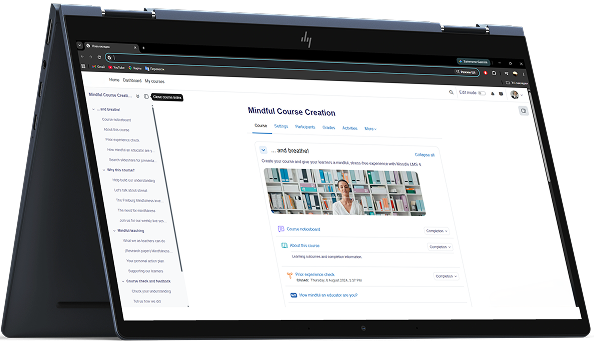
Courses and learning materials
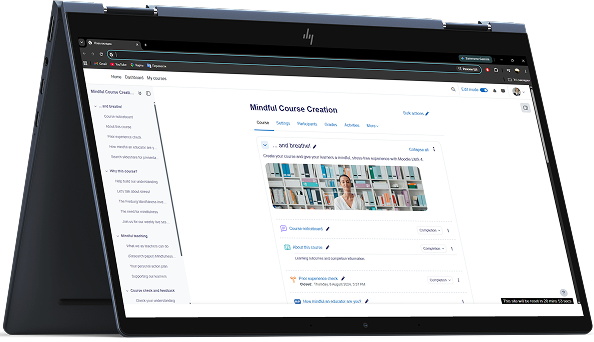
Editing a course without a developer
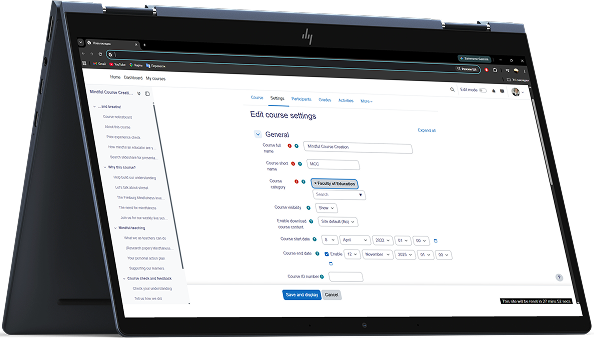
Course settings and multilingual support
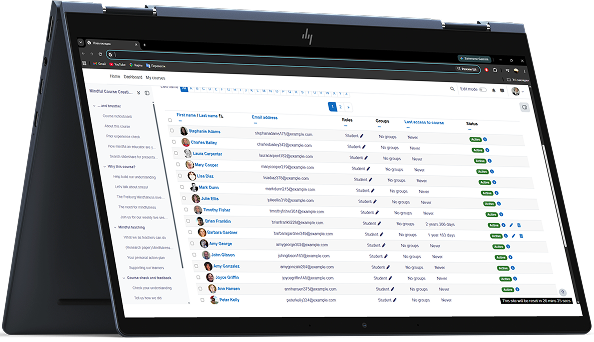
Administration, roles and permissions
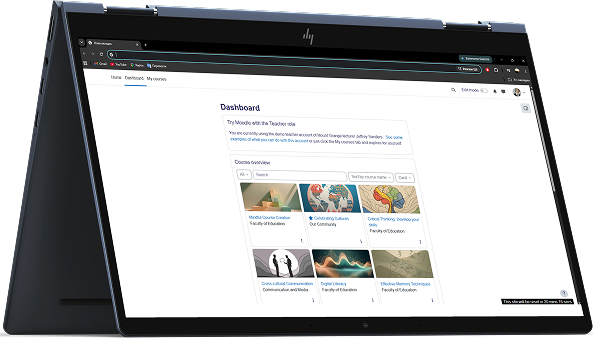
One space for the admin and for the employee
Moodle development and implementation services
We work both on platforms built from scratch and on inherited installations that need to be brought up to date. The scope always starts from what the company already has.
Building a Moodle platform around your processes
LMS development, or building a distance learning platform from scratch, starts from how training really happens at your company: who assigns courses, who checks the result, and what should happen when someone fails a recertification.
- Designing the course structure, roles and role-based learning paths.
- Deploying the platform in your own infrastructure or on managed hosting.
- Building a learning platform on top of an existing installation.
- Developing a distance learning platform for your course and assessment formats.
- Custom Moodle development wherever the standard logic is not enough.

Moodle configuration and customization
Moodle configuration is not a logo and a colour scheme. Configuring the Moodle platform means access rights, learning scenarios and how quickly an employee finds the course they need.
- A theme in your brand book and a multilingual interface.
- LMS setup by role: administrator, instructional designer, department head, learner.
- Automatic course assignment by position, department or hire date.
- Moodle adjustments for internal policies: deadlines, repeat assessments, notifications.

Moodle module and plugin development
When the feature exists neither in the core nor in the plugin directory, we write it ourselves. Moodle development and Moodle module development follow the official platform standards, so our code never blocks an upgrade.
- Moodle module development: custom activity types and blocks.
- Moodle plugin development: reports, authentication, course enrolment.
- Custom reports for the metrics your HR or compliance team tracks.
- Bespoke Moodle development with the code and documentation handed over to you.

Integrating Moodle with corporate systems
A learning platform is useful as long as it does not become yet another system with its own login. Integrating Moodle with corporate systems removes manual user management and double data entry.
- Active Directory, LDAP and SSO — one sign-in with the corporate account.
- Moodle and HRM integration: the department and position structure syncs automatically.
- Moodle integration with CRM and ERP — training for partners, dealers and contractors.
- Data exchange over REST API, webhooks, LTI and the SCORM and xAPI standards.
- Feeding training metrics into BI for management reporting.

Moodle migration and version upgrades
The most common request is not a fresh install but sorting out an installation nobody dares to upgrade. Moodle migration is a managed project, verified on a copy first.
- Moving courses, reports and the user base without losing progress.
- Upgrading to the current LTS release on a modern stack: PHP 8.2+, PostgreSQL or MySQL, a supported OS.
- Moving from another LMS, or from file sharing, to a real distance learning system.
- A trial migration, data reconciliation and a rollback plan before going live.

Moodle support and further development
A platform keeps living after launch: security releases arrive, courses and departments are added. Moodle technical support means this does not quietly become your administrator’s side job.
- Regular core and plugin updates, security patches included.
- Performance monitoring and tuning as the user count grows.
- Moodle support under an SLA: incident response and consulting for your administrators.
- Platform evolution: new integrations, reports and Moodle adjustments on request.

Moodle LMS implementation stages: from audit to a working platform
LMS implementation is not software installation. Before the first course exists we work out the roles, the sources of employee data, and the security requirements the platform has to pass.
Requirements analysis and data audit
We look at how training happens today: who creates courses, how completion is recorded, which reports management and compliance need. If an installation already exists, we separately assess its version, stack, data condition and the internal security review it has to pass.
Platform design
We lock down the course structure, roles and permissions, role-based learning paths and the list of reports. This is where it becomes clear what Moodle configuration can cover and where custom development is required.
Development and customization
We deploy the platform, set up roles and learning scenarios, and bring the interface in line with your brand book and language requirements. Moodle module development and custom reports run in parallel when they are in scope.
Integrations and data migration
We connect Active Directory, LDAP or SSO, HRM and any other system that supplies users and the department structure. Courses, reports and the user base are migrated with verification on a staging environment first.
Launch, training and support
We verify the learning scenarios, access rights, performance under load and report accuracy, then take the platform to production. Your team receives documentation and training: how to create a course, assign it to a department and read a report. After that we work under an SLA: updates, Moodle support and new capabilities as they are needed.
Moodle for corporate training: which companies it fits
You have more than 100 employees and onboard people regularly
An employee training platform assigns the course on the start date.
You have mandatory courses and need to prove completion
A corporate LMS records the date, attempts and result — audits take minutes.
The company has units in several regions or countries
An enterprise LMS with per-unit permissions and several interface languages.
You need to train partners and dealers, not only staff
Extended enterprise LMS: dealers and contractors learn on the same platform.
Your current LMS fails security requirements or is never updated
An outdated stack and deferred patches fail the internal security audit.
You want a platform that stays yours
Moodle for enterprise under the GPL: no per-user fees, no course limits.
Frequently asked questions about Moodle LMS
What is Moodle LMS?
Moodle is the most widely used open-source learning management system (LMS) in the world. In short, an LMS is an environment that holds learning materials, courses, tests, user roles and completion reporting in one place.
The platform is distributed under the GPL: it can be deployed on your own infrastructure, changed to fit your needs and extended with modules. That is why it is used both by universities and by companies — from small teams to enterprise LMS deployments with tens of thousands of users.
Which companies is Moodle a good fit for?
Moodle for business makes sense once training is regular and its outcome has to be recorded: onboarding, mandatory security and compliance courses, recertification, partner and dealer training.
The practical threshold is roughly 100 users, or a handful of mandatory courses per year. Below that, simpler tools are often enough; above it, manual spreadsheets stop working and an LMS costs less than administering the absence of one.
How long does a Moodle implementation take?
A base platform with configured roles, a branded interface and the first courses usually takes 4–8 weeks. The timeline depends on the number of integrations and on how much content has to be migrated.
Projects involving a large course migration and custom development run longer. Modernizing the LMS for one of the largest banks in Ukraine — a stack upgrade, single sign-on integration and a full migration of courses, reports and the user base — took 6 months.
Can Moodle be integrated with CRM and ERP?
Yes. Moodle integration with CRM is done through the platform REST API, webhooks or a middleware service — creating users from CRM records for dealer training, for example. Moodle integration with ERP is usually needed to push course completion into the accounting system and to sync the department structure from HRM.
Single sign-on is configured separately — Active Directory, LDAP or SSO. For content from external providers the SCORM, xAPI and LTI standards are supported.
Can Moodle be adapted to our company needs?
Yes, and it is the main reason companies choose this platform. Moodle customization covers the brand-book theme, the multilingual interface, roles and permissions, course assignment scenarios, report formats and notification logic.
Where configuration is not enough we extend Moodle in code — following the official platform standards, so future core updates do not break the custom functionality.
Do you develop custom Moodle modules and plugins?
Yes. Moodle module development and Moodle plugin development are a dedicated service line: custom activity types, blocks, reports, authentication methods and enrolment plugins.
We write plugins against the platform architecture instead of patching the core: a patched core turns every security update into a project of its own. The code of custom modules and its documentation are handed over to you.