


Moodle LMS for the Public Sector
IWIS builds, implements and adapts Moodle LMS for government institutions — to their structure, processes, roles and reporting requirements
Discuss your projectMoodle LMS for government institutions
Moodle for the public sector is not a separate “government edition”: it is the same open-source learning platform, tuned to the processes of one specific organisation. IWIS designs, configures and develops an LMS for the public sector so that it matches how the institution actually works — a central office and regional branches, different grades of position, its own access rules and its own reporting requirements.
One platform covers the full cycle: staff training and professional development, assessment and certification, a library of learning materials, roles and access rights, learning analytics and integrations. Moodle for government institutions runs inside your own infrastructure, so training data never leaves the organisation.
To scope the work and the timeline for your institution, start with a free consultation.

Your structure, not a template
Course categories and user groups follow the real structure: central office, regional bodies, directorates and departments. A new unit is added as configuration, not as a separate project.

Roles that match real positions
Administrator, instructional designer, training officer, head of unit, learner. Each role sees exactly the data its duties require.

The platform belongs to the institution
Moodle is distributed under the GPL: no per-user fee and no course limit. The system is deployed on the institution’s own capacity.

From one department to a national network
Moodle LMS works the same for a hundred users in a single directorate and for a branched structure with regional offices.

Ukrainian interface and mobile access
The interface is in Ukrainian, with a second language alongside it when needed. The platform works on mobile, so learning is not tied to a desk.

Open source and control of your data
No dependence on a single vendor: we hand over the code of custom modules and the documentation, and learning data stays within your perimeter.
5 signs an institution needs its own learning platform
The need for a civil-service training system becomes obvious not when the budget appears, but when training happens and there is nothing to prove its result.
What the learning platform looks like inside
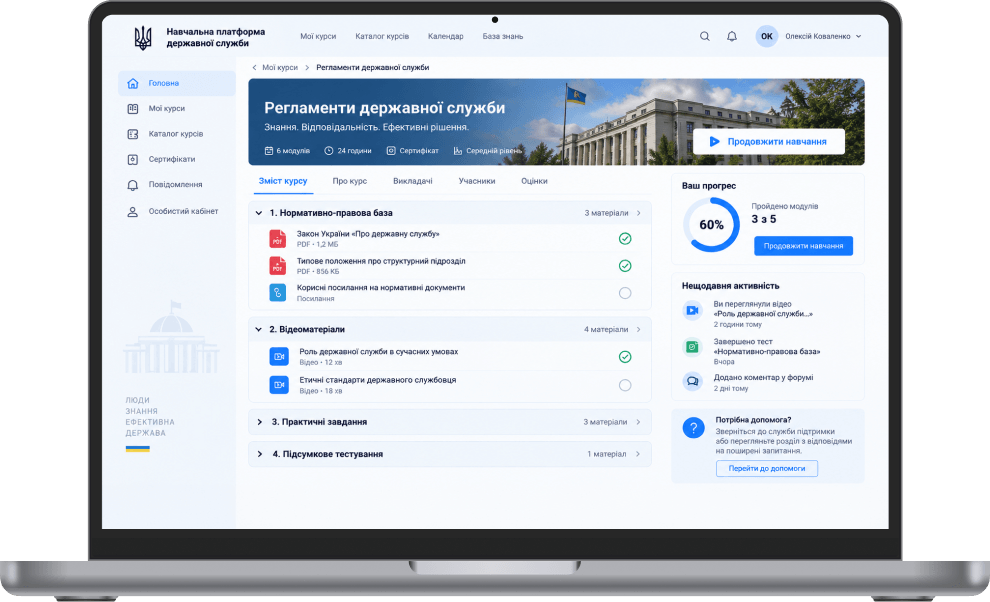
A course of regulations, video and practice
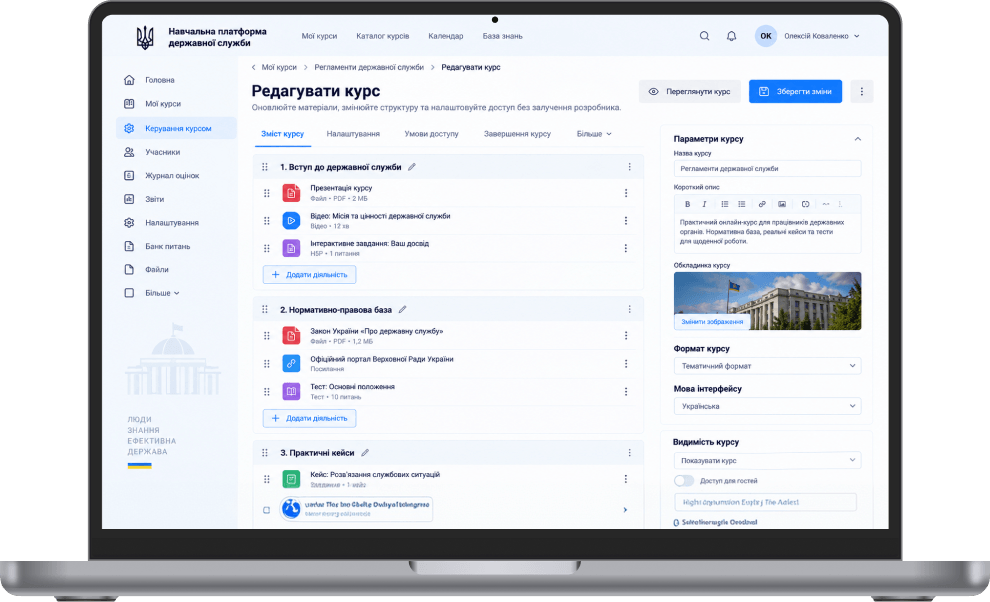
Updating materials without a developer
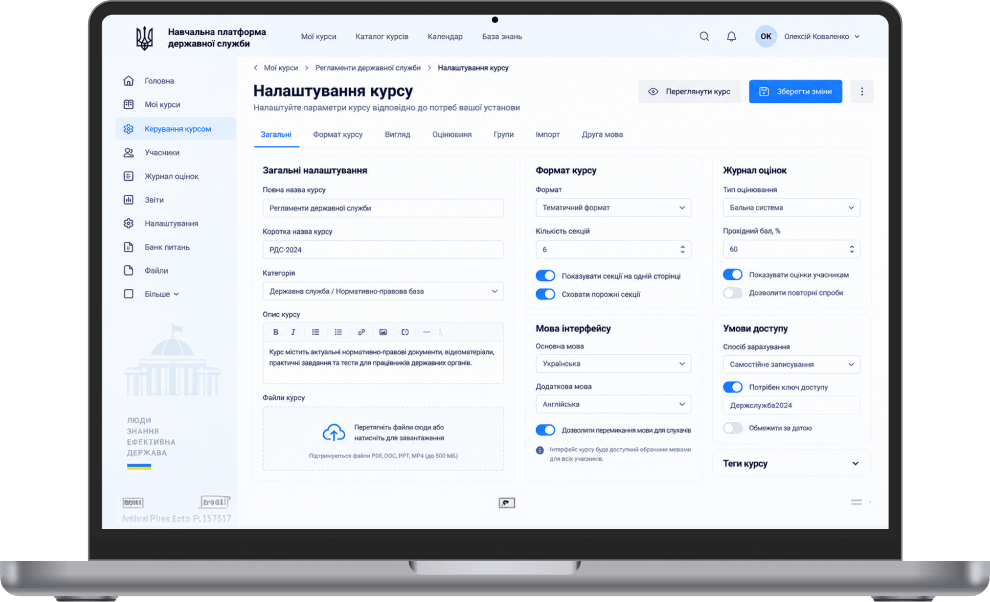
Course settings and a second language
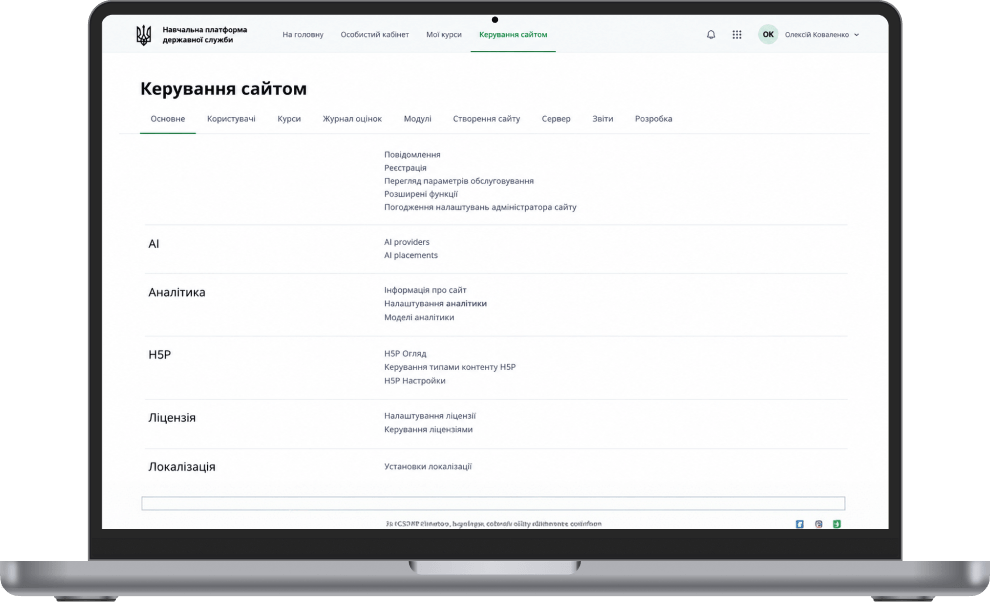
Administration, roles and permissions
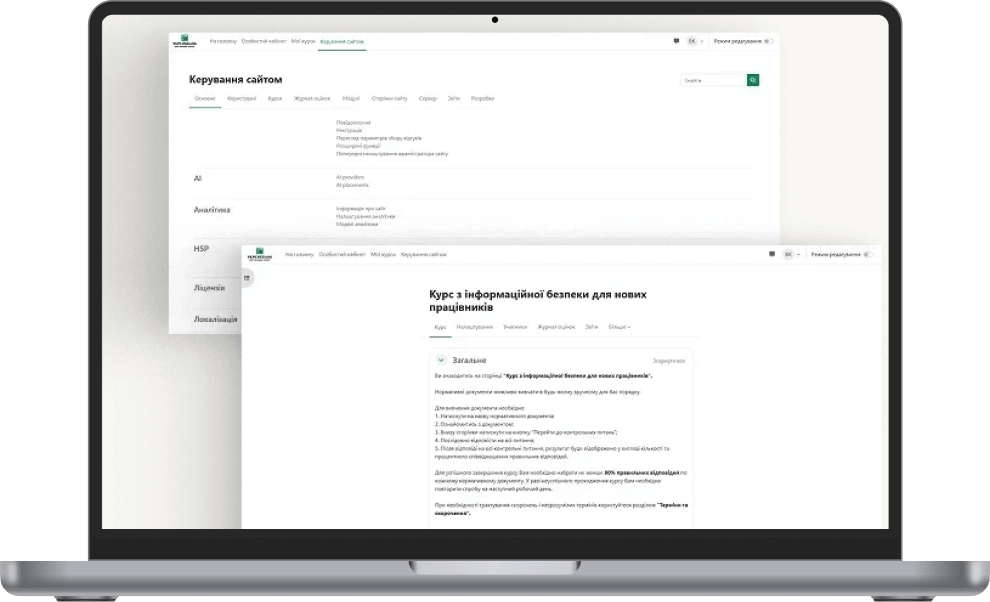
One space for the administrator and the employee
What Moodle LMS covers in a government institution
The scope of any project starts from what the institution already has: existing materials, current procedures, internal systems and reporting requirements.
Staff training and professional development
Professional training for civil servants becomes a managed process with a recorded result, and distance learning removes the dependence on a place and a timetable.
- Onboarding: the course is assigned automatically on the first day — the structure of the institution, its procedures, its working systems.
- Professional development programmes for civil servants with deadlines, stages and a final assessment.
- Repeat completion after a procedure changes — everyone affected receives the task.
- Building digital competencies of civil servants: internal systems, document management, citizen-facing services.
Assessment, certification and knowledge control
Knowledge control has to produce a verifiable fact rather than a tick: who passed, when, on which attempt and with what score.
- A question bank with random selection and limits on time and attempts.
- Assessment and certification of staff by position and unit, with a pass mark.
- A certificate on completion, a learning history per employee and reminders before a deadline.
A single library of learning materials and knowledge
A library in one place solves the core problem of a distributed institution: every unit works from the same current version of a document.
- Courses, instructions, regulations and video in a structured, searchable catalogue.
- Central updates: a change is made once and is immediately available to every unit.
- Support for external content in SCORM, xAPI and LTI.
Roles, access rights and the structure of units
A learning management system has to mirror the hierarchy of the institution. In Moodle, rights are granted not “to the system” but to a specific context: a course category, a course or a group.
- User groups by unit, grade of position and area of work.
- Custom roles for real areas of responsibility, beyond the standard set.
- Automatic enrolment by position, unit or appointment date.
Learning reporting and analytics
Analytics is usually the reason an LMS for government institutions is introduced at all: a report has to take minutes, not be assembled from spreadsheets across units.
- Progress and completion by unit, group, position and period.
- Assessment results down to the individual question.
- Consolidated reports for responsible officers, plus custom formats where the standard ones fall short.
Integrating Moodle with internal systems
The platform is useful when it does not become one more system with a separate login and a separate list of employees. Integration removes manual user management.
- Single sign-on through a corporate account: Active Directory, LDAP or SSO.
- Synchronising users and the structure of units from the HR system.
- Data exchange through the platform’s REST API, webhooks and middleware.
Customising Moodle to the institution's requirements
Customisation is not a logo and a colour — it is how closely the platform’s scenarios match the institution’s real processes. We write code to the platform’s official standards rather than patching the core: otherwise every security update becomes a project of its own.
- An interface in the institution’s visual style and full Ukrainian localisation.
- Module and plugin development: custom activity types, blocks and reports.
- The code of custom modules and the technical documentation are handed over to the institution.
Stages of a Moodle LMS rollout in an institution
Implementing Moodle is not installing software. Before the first course exists we work through the roles, the sources of employee data and the requirements the platform has to satisfy inside the institution.
Requirements analysis
We look at how training happens today: who prepares the materials, how completion is recorded, which reports management needs, and which grades of position and units the platform has to cover. Where an installation already exists, we assess its version, stack and data separately.
Platform design
We fix the course structure, roles and rights, learning paths by position and the list of reports. This is where it becomes clear what configuration covers, what needs custom development, and what each option costs.
Configuration and development
We deploy the platform inside the institution's infrastructure, configure roles and learning scenarios and bring the interface to the required style and languages. Module and custom report development runs in parallel where it is in scope.
Integrations and migration
We connect the user directory for single sign-on, the HR system and other internal systems. Existing courses, materials and completion history are migrated after a check on a test environment, with a rollback plan.
Launch and support
We verify the learning scenarios, access rights, performance under load and the accuracy of the reports, then move the platform into production. The institution's team receives documentation and training, and Moodle support then runs under an SLA: security updates, monitoring and further work on request.
Which government institutions Moodle LMS suits
Administrative service centres (ASC)
Moodle for administrative service centres covers training for front-desk staff, refreshing their knowledge of services and procedures, and assessment after every change.
Local self-government bodies and councils
Moodle for local self-government bodies: onboarding for new appointees, internal courses and competency development.
Regional and district state administrations
Moodle for public authorities: professional development, internal programmes and completion tracking across structural units.
Ministries, state services and agencies
An LMS for government institutions at the scale of tens of thousands of users: scalable training, a knowledge base, certification and accreditation.
State and municipal enterprises
Moodle for state and municipal enterprises usually starts with onboarding and briefings: work standards, internal regulations, training for individual units.
Employment centres, social and administrative bodies
Training for staff who deal with applicants every day: courses, updated procedures and knowledge checks.
State funds and organisations with a regional network
A single LMS for the public sector: a shared library for the central office and regional units, with separate access rights for each.
Frequently asked questions about Moodle LMS for the public sector
What can Moodle LMS automate in a government institution?
The platform takes on the whole training cycle: assigning courses by position or unit, deadline reminders, assessment, recording results and issuing certificates. Instead of a paper register and spreadsheets, the institution gets a single source of truth for who completed what, when and with what result.
Reporting is automated separately: analytics is produced by unit, grade of position and period, so preparing a report for management stops being a job that takes days.
Is Moodle suitable for training staff across different units?
Yes. The structure of the institution is carried into the platform as a hierarchy of course categories and user groups: central office, regional bodies, directorates and departments. Each unit gets its own set of courses and its own training officer.
For organisations with a regional network this is the main scenario: one LMS serves both the central office and the regional units. A local manager sees only their own team, while the central office sees the consolidated picture.
Can Moodle be used for professional development and assessment?
Yes. Professional development for civil servants is built as a programme of several courses with their own deadlines, a pass mark and a final assessment. The platform records attempts, scores and the completion date, and issues a certificate.
Assessment is configured separately from the learning materials: a question bank, random selection, limits on time and attempts. A learning history is kept for every employee and is available to the responsible officer.
Can different roles and access rights be configured?
Yes, and this is one of the reasons Moodle is chosen for the public sector. The standard roles — administrator, instructional designer, manager, learner — are extended with custom ones that match real positions and areas of responsibility in the institution.
Rights are granted not “to the system” but to a specific context: a course category, a single course or a group. A training officer in a regional unit therefore works only with their own users.
Can Moodle be integrated with the institution’s internal systems?
Yes. Integration is done through the platform's REST API, webhooks or a middleware service. The most common scenarios are single sign-on through a corporate account (Active Directory, LDAP, SSO) and synchronising users and the structure of units from the HR system.
SCORM, xAPI and LTI cover external learning content. The exact list of integrations is defined during requirements analysis, depending on the systems the institution already runs.
Can existing courses and materials be migrated to Moodle?
Yes. Courses, learning materials, the user base and completion history are all migrated. Where materials currently exist as documents, presentations and video, they are assembled into structured courses; where they sit in another LMS, export in standard formats is used.
Migration is run as a managed project: first a test transfer on a copy, then a data reconciliation, and only after that the launch in production. A rollback plan is prepared in advance.