


April 24, 2026

Back in 2014, Zara began tagging every garment with an RFID tag. This allowed store employees to quickly check whether the desired size was available at that location, at nearby stores, or online. Shoppers gained more ordering options, and the company didn’t lose sales simply because the item was located elsewhere in the chain.
This is one of the earliest examples of just how far the synchronization of sales channels can go when a company begins to view its own business as a single system comprising products, customers, and inventory. Most retailers still operate differently: the website shows that a product is in stock, but it’s already sold out in the store; a loyalty program card works only offline; a discount from an email doesn’t apply at the register.
The ability to integrate channels, data, and processes into a single system is called omnichannel retailing.
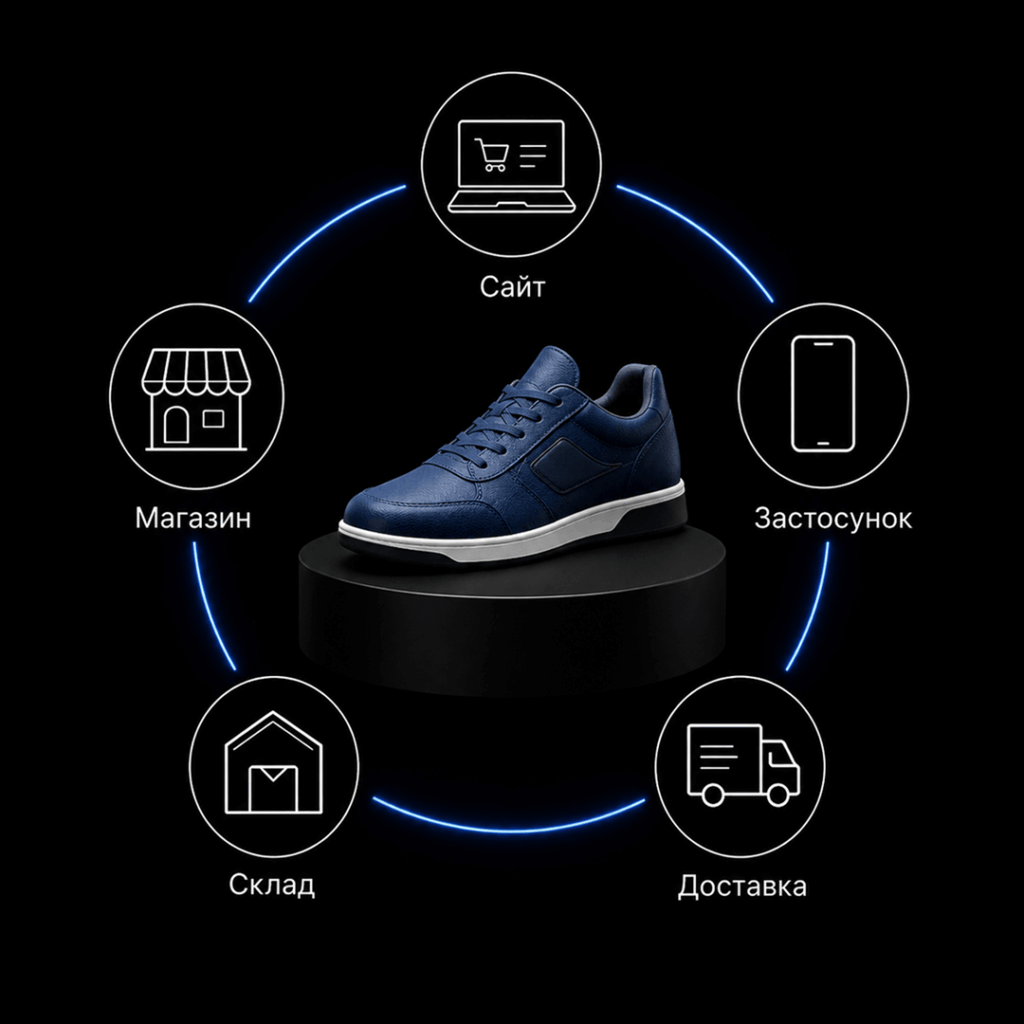
Omnichannel is an approach in which a company integrates its website, app, physical stores, messaging apps, and call center into a single system with shared data on customers, products, and orders. A customer can start selecting a product in the app, continue on the website, and pick up the purchase at a store. At every stage, the company can view the customer’s history, order status, and available rewards, and inventory information is updated across all channels.
These two concepts are often confused, although the difference is fundamental.
| Multichannel | Омніканальність | |
|---|---|---|
| Sales channels | Working in parallel, each separately | Combined into a single system |
| Customer data | Scattered across different bases | Single customer profile |
| Remaining goods | Calculated separately for each channel | Synchronized in real time |
| Buyer experience | Різний залежно від каналу | Єдиний досвід клієнта |
A multichannel business simply has a presence across several channels: there’s a website, a store, and an Instagram page. But each channel operates independently: a product that just arrived in the store won’t appear on the website for a few more days, and a loyalty card issued in-store doesn’t work in the app. Omnichannel retail eliminates these gaps. The channels remain separate touchpoints but share common data about customers, products, and orders. This creates a unified customer experience regardless of how the purchase is made.
The modern retail customer journey is rarely confined to a single channel. According to data updated in April 2026, 91% of consumers interact with retailers across multiple channels, and they have an average of 11 touchpoints before making a purchase. For retailers, this means that websites, apps, advertising, and physical stores are increasingly ceasing to function as isolated stages.
A person scrolls through a catalog on their app while commuting on the metro, compares prices on the website in the evening, and then drives to the store on the weekend because they want to see the product in person. A company that builds an omnichannel retail strategy does not try to keep the customer within a single channel — it makes the transition between them seamless.
Without integrating online and offline sales, a company loses orders, duplicates efforts, and delivers a disjointed customer experience.
Without a unified customer profile, each channel only sees a fragment of the bigger picture. A call-center agent has no idea that the customer just processed a return on the website. An in-store sales associate cannot see the loyalty points earned through an app purchase. Marketing sends a promotional email for a product that the customer already bought offline two days earlier.
The standard solution is a unified customer database at the CRM or CDP (Customer Data Platform) level, which ingests interactions from all channels.
The second common gap is inventory availability. The website shows an item in stock because synchronization with the warehouse runs only once a day. The customer places and pays for the order — only to receive an email an hour later saying the product is no longer available. In the physical store, the problem looks different: the sales associate cannot see that the required size is available at a nearby warehouse or in another store within the chain, losing a sale even though the product was actually accessible.
The third issue arises when online and offline operate under different rules. A promo code from an email doesn’t work at the checkout counter. A loyalty program joined in-store is inaccessible in the app. A product bought online can only be returned by mail, even though there is a physical store of the same chain nearby. For the customer, this comes across as inconsistency, which undermines trust.
For an omnichannel retail strategy to succeed in practice, four interconnected components must work in unison.
Every customer interaction with the brand — a store purchase, a product view on the website, a support call, or engagement with a newsletter — must feed into a single profile. Only then can a store associate view the customer’s online order history, and support staff see that the customer wrote in a chat about the same item just yesterday.
Technically, this is accomplished through a CRM or CDP (Customer Data Platform) that aggregates data from all touchpoints.
Product names, prices, and availability data must be consistent across all channels and updated in real time or near-real time. This applies to the website, physical stores, marketplaces, mobile apps, and all other sales channels.
Bonuses, discounts, and customer status must work consistently across all channels. If a shopper earns loyalty points from an in-store purchase, they should be able to see and redeem them in the app — and vice versa. A disconnected loyalty program is one of the most common reasons why customers perceive an otherwise omnichannel brand as a collection of unrelated companies.
The final element is end-to-end analytics that maps the complete customer journey — from the very first ad touchpoint to the repeat purchase — regardless of how many channels the customer used along the way. Without this, the retailer only sees scattered fragments: marketing reports on ad clicks, the store reports on checkout revenue, but the system fails to show the connection between them.
Each of the above elements relies on a specific technology layer. Three of them are foundational for any omnichannel retailer:
| Technology | What decides |
|---|---|
| CRM / CDP | Single customer profile, interaction history, personalization |
| OMS | Cross-channel order and balance management |
| BI analytics | End-to-end reporting across all channels in one dashboard |
CRM, CDP, OMS, and BI must exchange data with the retailer’s point-of-sale, accounting, and inventory systems. Without integration with POS, ERP, or PIM, it is impossible to maintain up-to-date prices, product catalogs, and inventory levels across all channels.
Omnichannel CRM stores the history of customer interactions and helps sales, marketing, and support teams work with shared information. CDP consolidates data from various systems—including product views, clicks, shopping carts, and other behavioral events—to create a comprehensive customer profile.
An example of such an implementation is the Good Wine case study: the company was already using Salesforce Marketing Cloud for email and push notifications, but the system did not take into account customer behavior on the website, so personalization capabilities were limited. The IWIS team integrated the CRM with the website, added automated product recommendations based on user interests, and configured the system to send messages at the optimal times. As a result, the brand’s communications began to better align with customers’ current behavior.
OMS processes orders from all channels using a unified logic. The system determines which warehouse or store is the most efficient location to ship goods from, and whether an online order can be prepared for pickup at the nearest retail location. This serves as the technical foundation for click-and-collect, returns of online purchases at physical stores, and accurate inventory tracking.
For retailers who are just beginning to build or redesign their online store for omnichannel scenarios, this process typically starts with e-commerce solutions integrated with the company’s accounting systems.
The BI system consolidates data from CRM, OMS, advertising platforms, and point-of-sale systems. On a single dashboard, retailers can view revenue by channel, transitions between purchase stages, and the contribution of various touchpoints to sales. It is at this level that retail automation moves from isolated reports to management decisions based on real-time data.
This requires BI analytics tailored to the retailer’s specific channels, business processes, and metrics.
Integrating online and offline sales requires a phased implementation: each subsequent stage builds on the data and processes established in the previous ones. Attempting to launch all elements at once usually leads to a prolonged implementation process and confusion among teams.
In many cases, these steps can be implemented in stages without completely halting sales. To do this, integrations are planned taking into account the existing IT infrastructure and gradually transferring systems to the new processes.
Free consultation from IWIS
If you need to understand where to start implementing omnichannel in your business, the IWIS team conducts a free consultation. During the meeting, the team analyzes sales channels, customer data and balance accounting system, after which it proposes an integration plan in accordance with the company's processes.