



April 24, 2026

The line at the IKEA checkout always winds past a stand selling hot dogs, candles, and small home decor items. According to a study, IKEA shoppers who ate in the food court spent, on average, twice as much on home goods as those who didn’t stop to eat. For years, the company has been designing the store layout so that customers leave with a shopping cart much fuller than the one they planned to bring in.
In a physical store, this requires a well-thought-out shopping route. But in an online store, the same effect can be achieved without any physical location—through the right recommendation blocks, bundles, and a free shipping threshold. And it is precisely these tools that typically influence the average check: the amount each customer leaves in their cart.
Average transaction value is the average amount a single customer spends per purchase. It shows how effectively a store sells to customers who have already decided to buy.
It is one of three metrics that determine revenue, along with the number of visitors and conversion rate. Increasing traffic and conversion rates is more expensive because it requires a larger advertising budget. You can increase the average order value without spending a single extra hryvnia on customer acquisition, simply by changing what customers see in their cart and at checkout. So how do you calculate the average order value?
Let’s take a closer look at the average order value. The formula is simple—it only requires two numbers.
Average order value = Total revenue for the period ÷ Number of orders for the same period
For example, with 500,000 UAH in revenue and 800 orders per month, the average order value is 625 UAH.
To get a more accurate picture, it’s worth calculating several versions of this metric:
| Metrics | What does it show? |
|---|---|
| Average check for all orders | Overall sales performance |
| Average check for new customers | How much does a buyer leave upon first contact? |
| Average check of regular customers | How loyal an audience buys more |
| Average check per traffic channel | Which advertising brings in a more affluent audience? |
If you look only at the overall metric, it’s easy to overlook the fact that customers coming from organic search have an average order value twice as high as those from paid advertising, while the budget is allocated the other way around.
There’s no one-size-fits-all figure here: an average check that’s considered excellent for a pet supply store would be a failure for a furniture or jewelry retailer, since the cost of goods in these niches differs significantly. This is also confirmed by industry benchmarks: the average check in the media category is measured in tens of dollars, while in the travel or home goods categories, it’s already in the hundreds.
That’s why it’s important to track the dynamics of the average order value: whether it’s growing month over month, whether the margin covers the cost of customer acquisition, and how it changes after each promotion or change to the checkout process.
The average order value doesn’t always fall due to external factors like a crisis or seasonality. Most often, the reason lies in how the store itself is structured.
Most of these issues can be resolved by changing the store’s business model. Which leads to the next question: how to increase the average check without spending extra money on attracting new customers.
In coffee shops, this is clearly seen in the difference between small, medium, and large drink sizes: the larger option often seems like a better deal, even if the customer initially planned to buy the basic size. In e-commerce, the same principle works by displaying a premium version of a product alongside the basic one, with a clearly visible difference in features.
The question “Would you like fries with that?” has become a symbol of successful upselling because it feels natural: the customer has already decided to eat; all that’s left is to expand their order. In an online store, this role is fulfilled by the “Customers who bought this also bought” section. The key is to ensure the suggestion is genuinely related to the purchase, rather than displaying random items from the catalog.
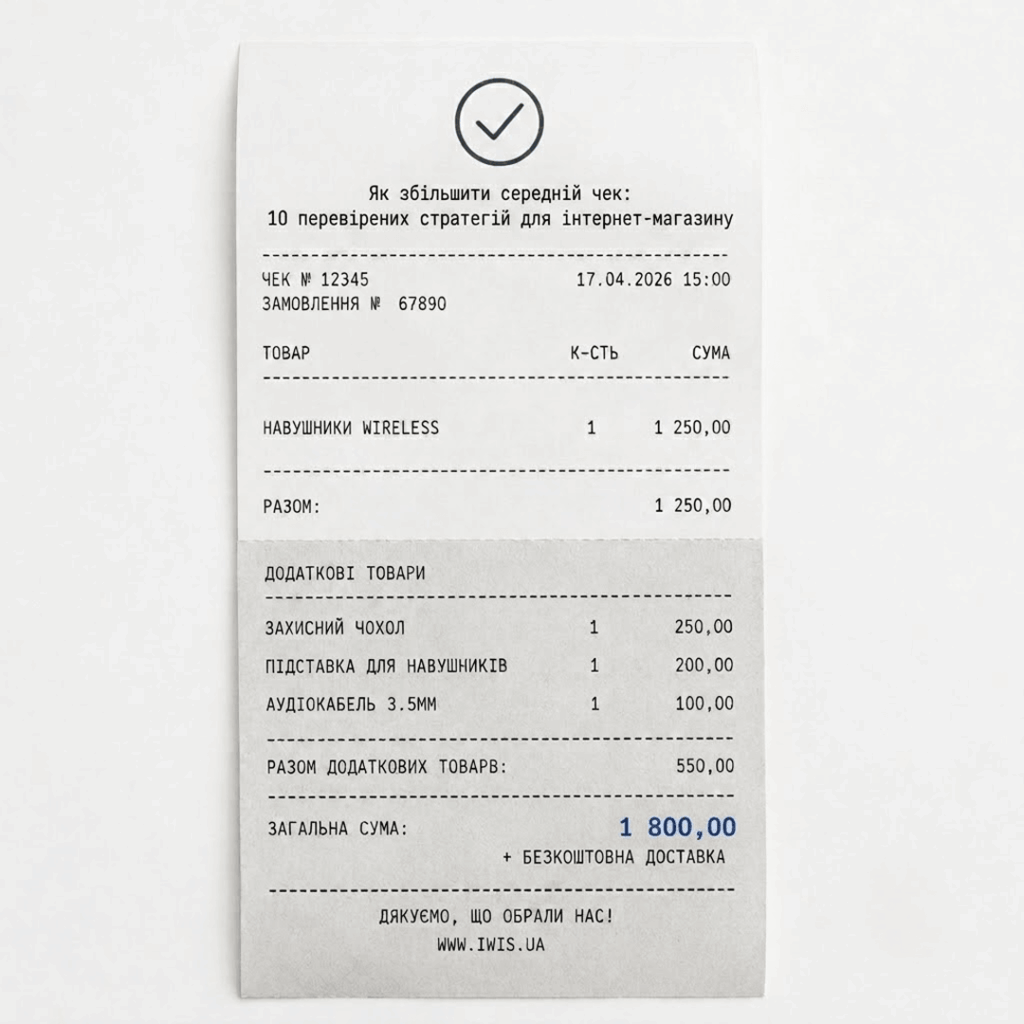
A set, rather than three separate items, reduces the burden of choice: the customer doesn’t have to search online to find out which case fits their headphones, because the store has already done that work. IKEA uses the same principle in its showrooms, where furniture is displayed as a complete room.
A free shipping threshold works well when it’s easy for a customer to add an inexpensive but necessary item to their cart. If the average order is 800 UAH and the threshold is set at 1,000 UAH, some customers will deliberately add one more item to avoid paying for shipping.
Regular customers are more likely to agree to upsells because they already trust the store. This is how the Starbucks Rewards program works, for example, which retains its audience through a points system rather than discounts. In e-commerce, this role is fulfilled by purchase points, cashback, or early access to new collections.
Recommendations based on browsing history follow the principle of a sales consultant, only automated: the system suggests items that logically build on the customer’s previous choices—such as a camera lens or dog food for the breed the customer has already purchased for. Effectiveness depends on data quality: an irrelevant recommendation only adds to frustration.
Limits on time or quantity work based on the principle of scarcity. It’s easier to make a decision when there’s a risk of missing out. The key is for the limit to be genuine: shoppers quickly recognize a fake timer that resets daily, and this damages trust more than it boosts the average order value (AOV).
68% of businesses offering BNPL options report an increase in average order value, with an average AOV growth of 15%. For mid- to high-priced items—such as electronics, furniture, and appliances—paying in installments removes part of the psychological barrier: the buyer doesn’t see the entire amount at once, but rather a manageable payment.
A fixed-amount gift certificate often encourages the recipient to buy something extra; rarely does anyone spend exactly the face value of the card. The store benefits in two ways: it gains a new customer and sees an increase in the total purchase amount from the person who bought the certificate.
A large e-commerce site can, on average, increase checkout conversion by 35% through UX improvements. It’s worth testing not only button colors but also the placement of the recommendations block, the order of checkout steps, and the moment when the customer sees the shipping cost.
All these strategies are effective only when based on actual customer behavior. It’s important not only to know how to calculate average order value but also to understand which products, channels, and customer segments contribute to it.
Analytics is useful for average order value in three ways:
| Task | What does it give for the average check? |
|---|---|
| Customer segmentation | Shows who is willing to pay more — and shows premium offers to them, not to the entire database at once |
| Analysis of commodity relations | Reveals which products are actually purchased together, instead of intuitive assumptions about cross-sell |
| Check tracking in real time | Allows you to see the effect of each change separately |
Without this layer of data, any strategy to increase average order value is a shot-in-the-dark experiment, the results of which can neither be measured nor replicated. If your store has outgrown spreadsheets, it’s time to implement e-commerce analytics. You can read more about the basic metrics in our article “7 Metrics for an Online Store.”
Good Wine is one of Ukraine’s best-known brands in the premium alcohol and gourmet food category. The company was already using Salesforce Marketing Cloud for email and push notifications, but the system wasn’t living up to its potential: the content wasn’t personalized, and the platform couldn’t track user behavior on the website.
The IWIS team conducted an audit of the existing communication strategy and implemented AI-powered personalization modules: a system that automatically determines the optimal timing for sending messages, generates product recommendations based on customer interests, and combines website data with the CRM to create a unified view of user behavior. After the integration, email campaigns became more targeted and less intrusive, and the marketing team gained the tools to engage in personalized dialogue with each customer segment instead of relying on mass mailings. Learn more about the approach and results in the Good Wine case study.
Average order value is one of the few metrics that can be increased without a new advertising budget. The main question is whether you have the data to determine which strategies actually work for your specific store.
If you want to figure out exactly where your online store is losing money on each order, the IWIS team is ready to provide a free consultation on e-commerce analytics and identify your first areas for growth.