


Business Intelligence for e-commerce
Discover where your business is losing profit—and change it
Get a ReportWhat changes in your business after implementing Business Intelligence
Management analytics is not about beautiful charts. It is about a systematic transition from intuitive decisions to decisions based on real data from your business. When you see the full picture, profit grows because the number of costly mistakes decreases.

Profit/Expense Control:
You see not only revenue but all expenses broken down: where the budget is spent and how much remains after advertising and operational costs.

Margin per Product:
You know exactly which items generate profit and which drag margins down—and you adjust your assortment based on data.

Advertising Channel Effectiveness:
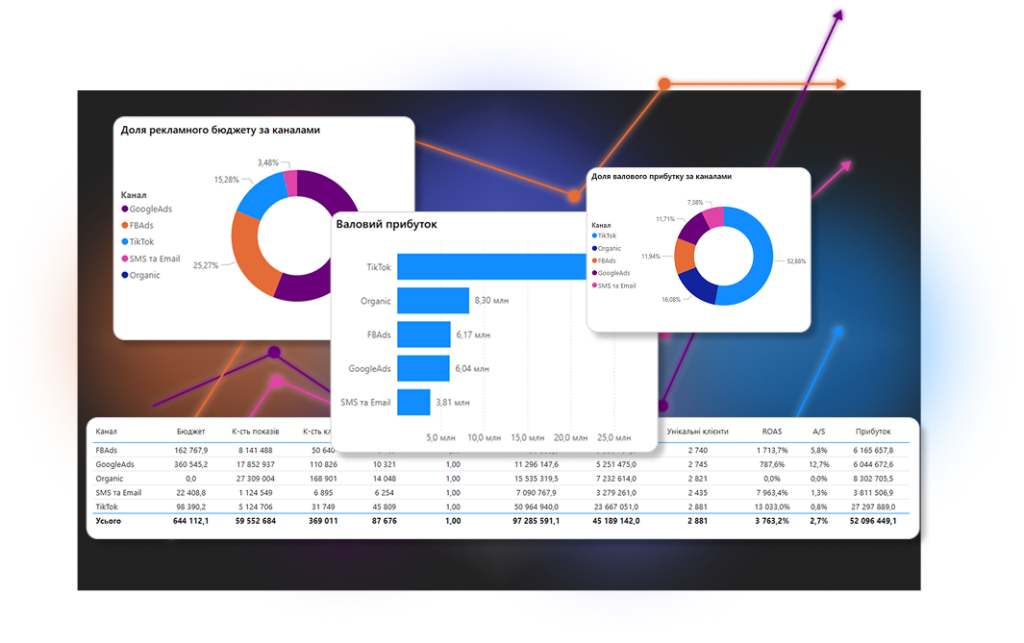
ROAS analytics shows not just return on ad spend, but net profit per channel—Facebook, Google, organic, retargeting.

Customer Analysis:
Segmentation helps you understand who generates the most revenue and who should be targeted with marketing.

Understanding Your Customer Base:
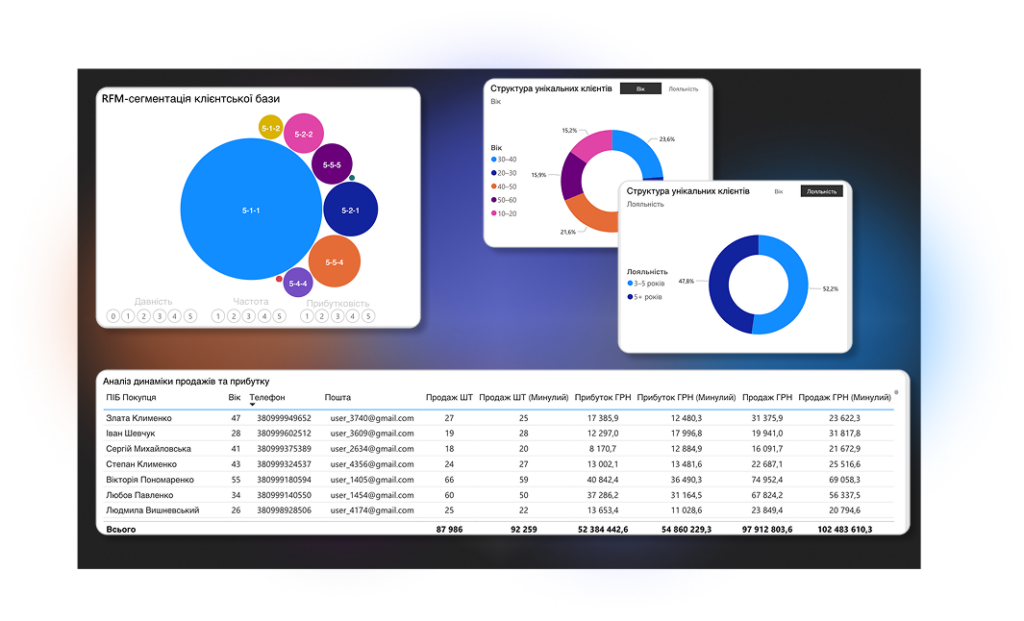
RFM segmentation divides customers into groups: who pays the most, who is leaving, who should be brought back—and how.

Identifying Budget Waste:
BI analytics automatically shows points where money is spent without results—and you react immediately, not at the end of the month.
5 Signs Your E-commerce Needs Business Intelligence Right Now
Many e-commerce businesses face a situation where advertising metrics grow, but profit does not increase. The owner sees revenue but does not understand what actually generates money. The reason is often not in advertising or the product—but in the absence of a unified analytics system.
What You Will See in Your Analytics
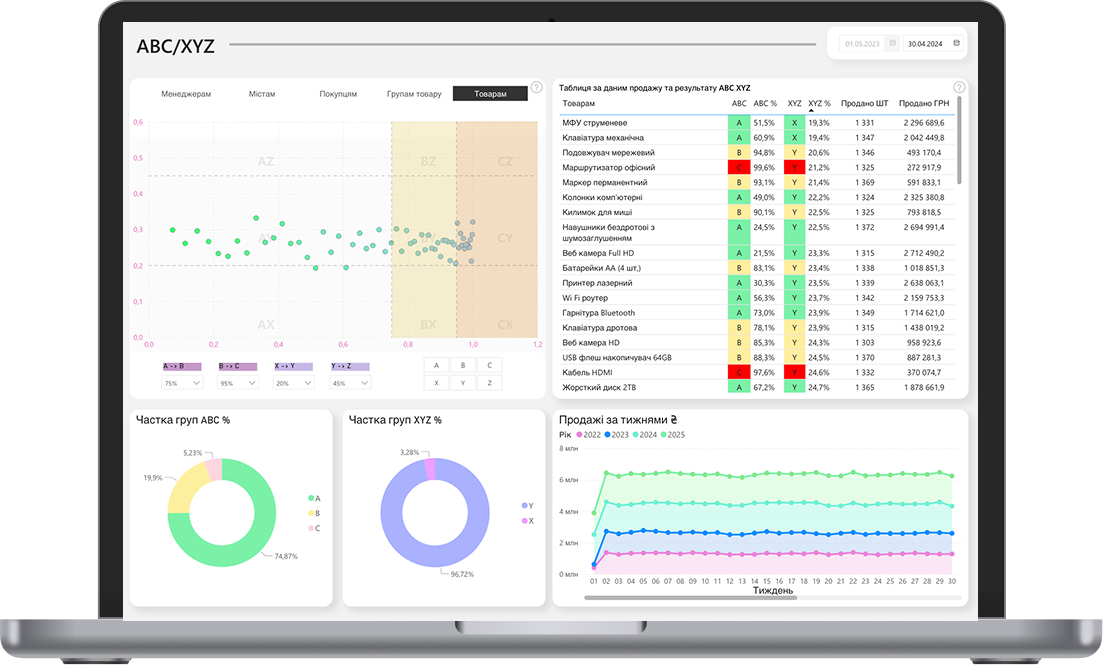
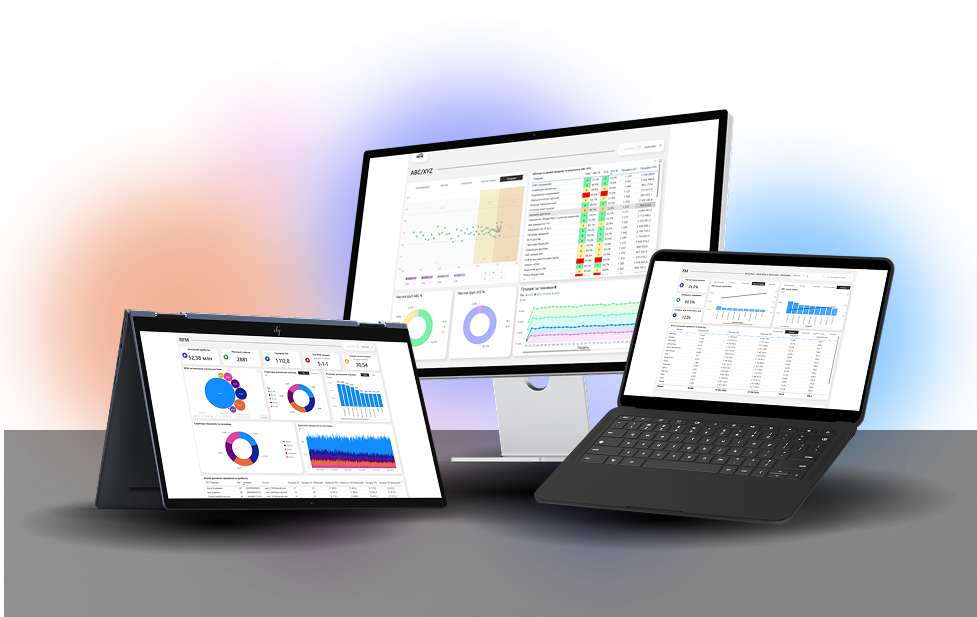
ABC/XYZ Product Analysis
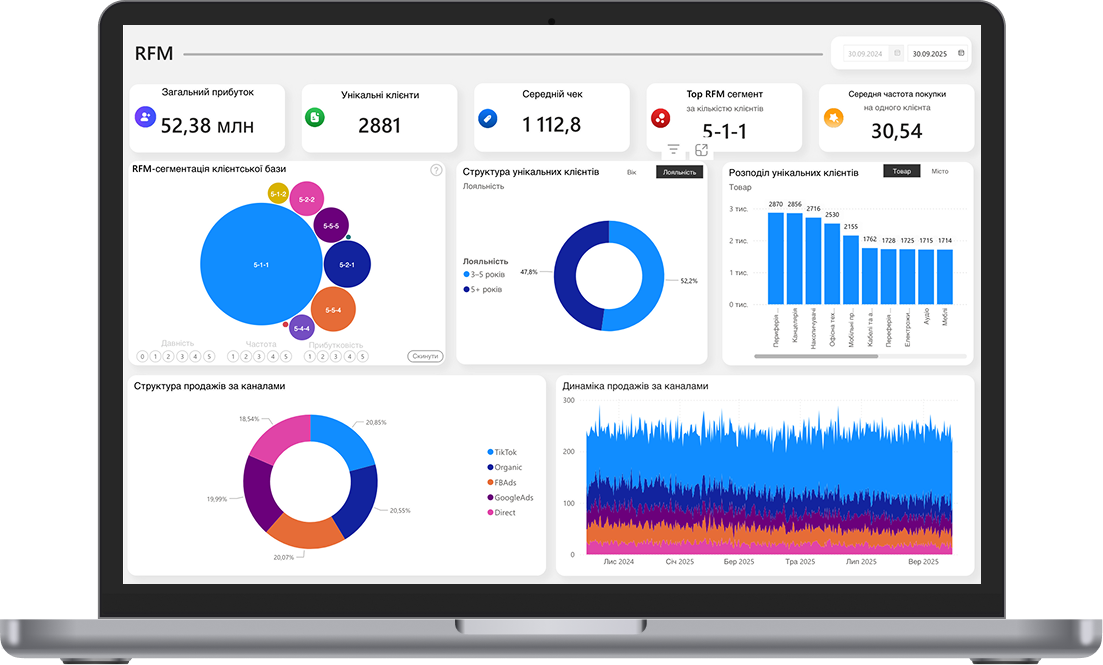
RFM Customer Segmentation
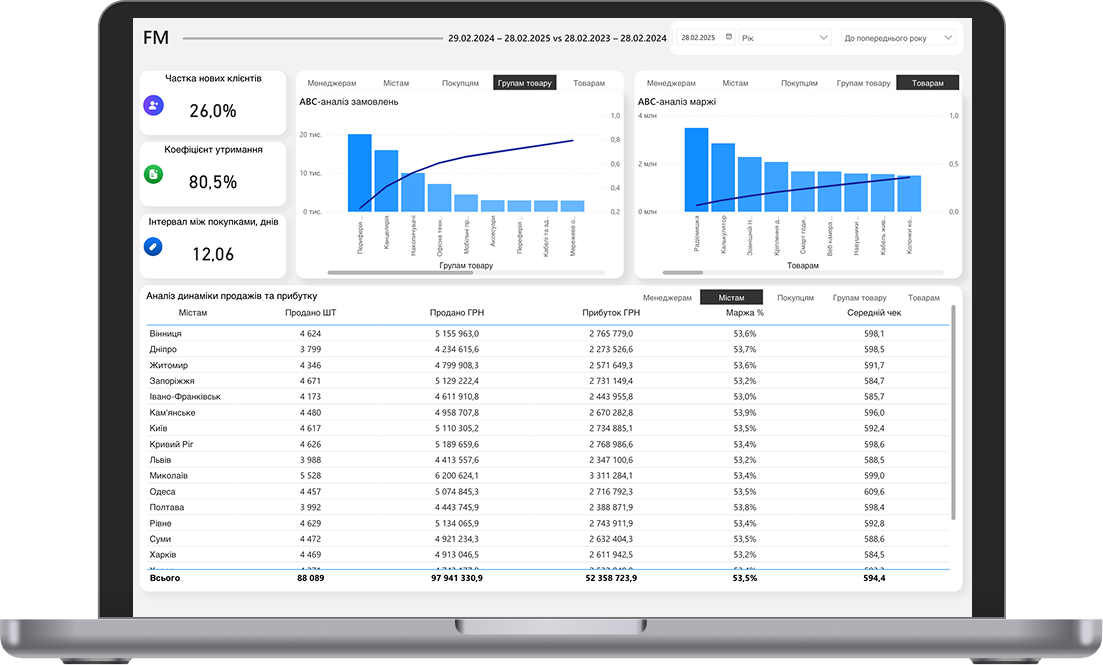
FM Customer Segmentation
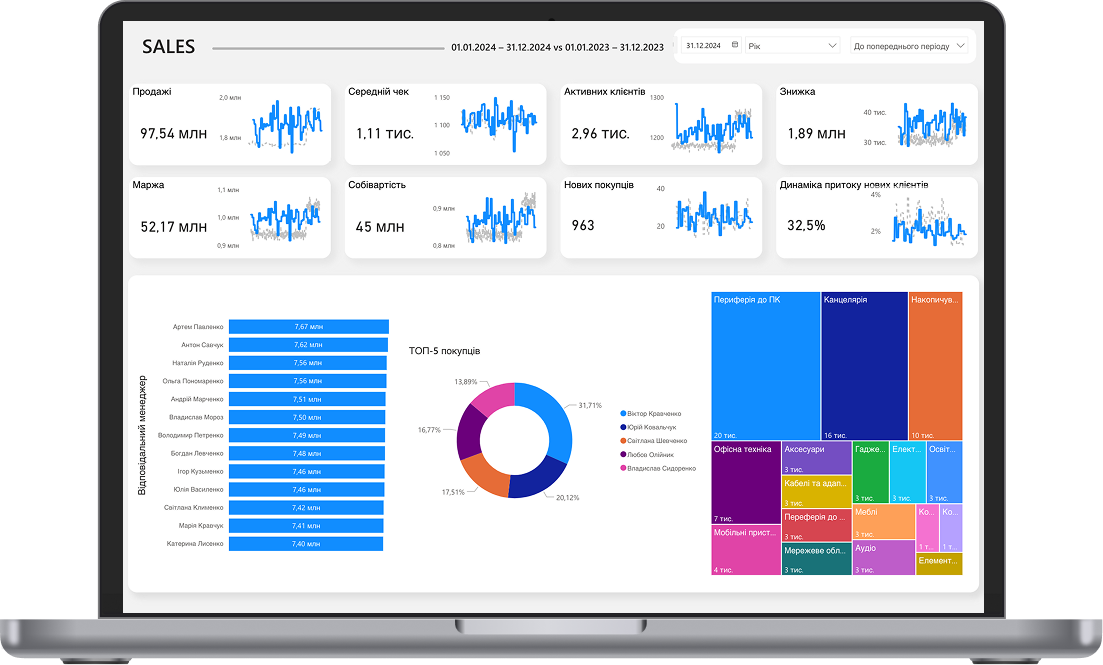
Profitability Analysis
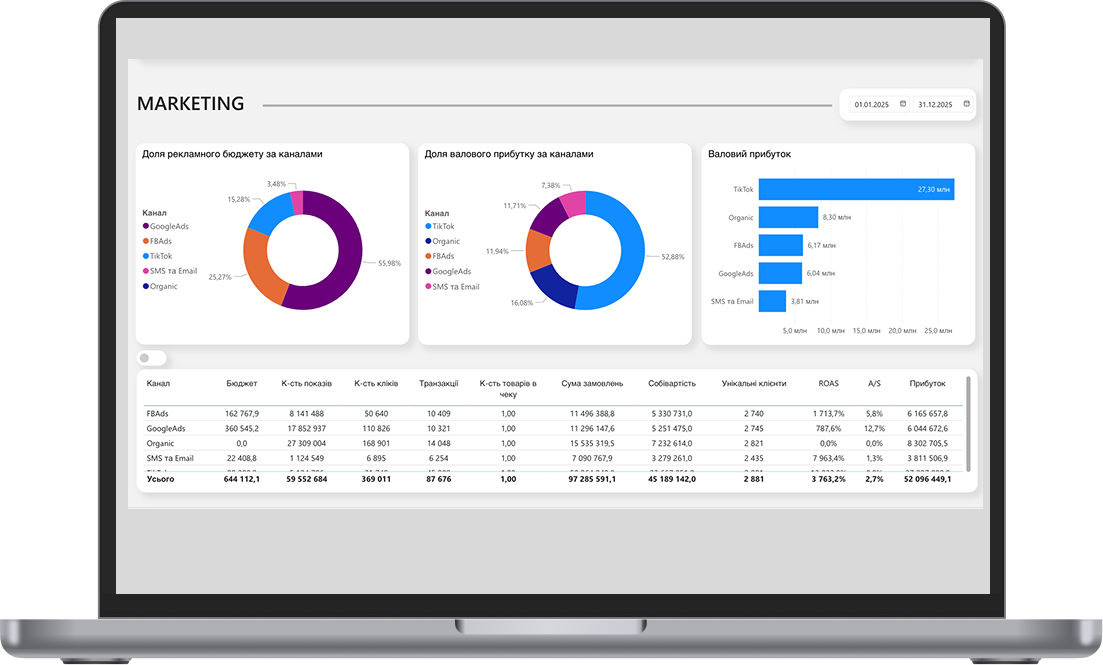
Advertising Channel Analytics
What is included in the BI package for e-commerce: full composition for $200/month
5 Dashboards in Power BI
These are not template reports—each module is designed for real e-commerce tasks: from daily profit control to identifying products that drag margins down. All 5 dashboards are interconnected: you move from general to specific in a few clicks, without switching between systems.
RFM Segmentation with Export
The system automatically divides the base into segments. You receive a ready file for upload to any other service—and launch personalized campaigns without additional analyst work.
Advertising Analytics Dashboard
Everything in one window—Facebook, Google, organic. You see not just ROAS, but net profit per channel after all costs. Budget reallocation decisions take minutes, not days of manual data collection.
Continuous Data Updates
Just 15 minutes of your time uploading files using a template. No APIs, no technical setup. You always see the current state of your business, not data from two months ago.
Technical Support
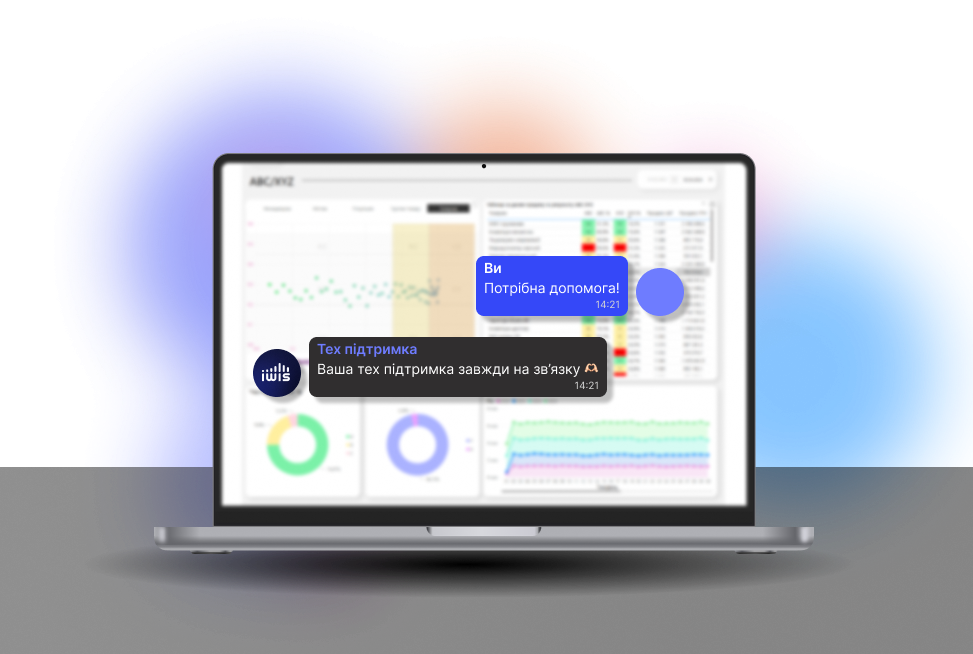
You are assigned a specific person who knows your system and your business. If something goes wrong, a question arises, or you need help interpreting data—you write directly to the manager, not to a general support chat without a name or face.
Training Materials
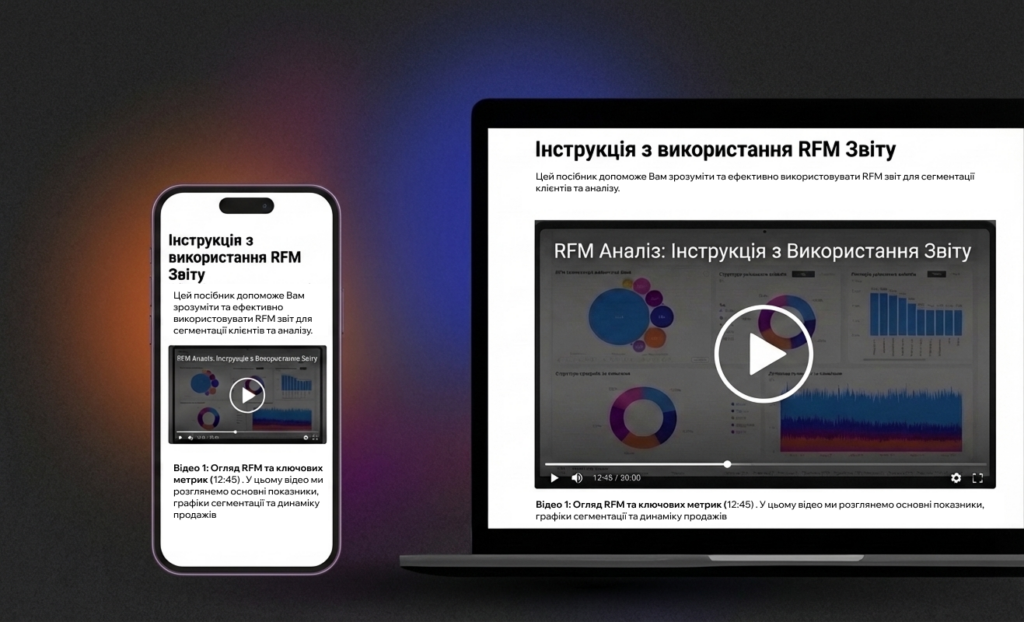
Many tools are purchased and not fully utilized—simply because it is unclear how to read the data correctly. Each dashboard includes a short video and text guide: what to look at, how to interpret metrics, and what decision follows from them.
Business Intelligence in 1 Day: 3 Steps to Launch Analytics
No integrations, no programmers, no technical tasks for a month ahead. From zero to a fully functional analytics system—one day.
Free Diagnostics
We analyze your business: what data you have, in what format, what tasks analytics should solve. Diagnostics takes 30–40 minutes and gives you a specific list of points where your e-commerce is losing money—regardless of whether you proceed further.
Data Upload Using Template
You receive ready templates for upload: orders, expenses, advertising data. The format is standard Excel or CSV, nothing new to learn. Preparation takes 1 to 3 hours depending on database volume.
Connection and Launch
You submit the completed files, we configure the dashboards and return a ready system. Your task is to review the results and ask questions. From this moment, business analytics for your e-commerce operates at full capacity.
Business Intelligence for E-commerce Is for You If…
E-commerce owner for 1+ years
Revenue from $15k+/month
2+ advertising channels
Existing customer base with regular sales
No unified profit analytics system
Business at a scaling or stress point
Frequently Asked Questions About Business Intelligence for Online Stores
How long does implementation take?
The first analytics work block typically takes 6-10 weeks from the start of diagnostics to dashboard launch. Full implementation with all blocks (finance, sales, operations) takes an average of 3-5 months depending on the number of data sources, the state of current systems, and client priorities. The phased approach allows you to see initial results before the entire project is completed.
Do existing ERP and CRM systems need to be changed?
The BI system is built on top of the existing infrastructure: it connects to ERP, CRM, and accounting systems and retrieves data from them through integration. There is no need to replace or abandon current systems. On the contrary, they become the sources for a unified analytical environment.
Who from our team needs to be involved?
At minimum, one relevant representative from the client side: a financial director or head of the respective department to validate business logic. Participation is required at specific points: during requirements alignment sessions and results verification. IT resources are only needed to provide system access.
Can we start with one area, for example, only finance?
A modular approach is standard practice. We begin with the module where there is the greatest management pain point or the highest value from quick results. Financial analytics, sales analysis, or the operational module—any of them can be launched first, and then the system can be scaled up.
What happens after launch? Do you provide support?
After system handover, we can provide support: technical, analytical, and consulting. When business logic changes or new tasks arise, the system is updated within the SLA framework.
Is the solution suitable for our industry and specifics?
The analytical model is developed according to the specific client's business logic. The approach works regardless of industry: retail, distribution, manufacturing, agriculture, services. There are no ready-made templates for everyone; everything is built around the company's real management tasks.