

April 24, 2026

In 2008, Netflix experienced a three-day outage: its corporate database crashed, and the company was unable to ship a single DVD to customers. It was then that management decided they would no longer build their own data centers and would switch to AWS. The ready-made cloud infrastructure solved the scalability problem.
But a few years later, it became clear that third-party CDN providers couldn’t handle the growing streaming traffic. Netflix needed control over video quality and delivery speed, but no off-the-shelf product could provide it. The company built its own content delivery network, Open Connect, which is now installed directly in the data centers of internet service providers around the world.
AWS remained for business logic and computing, while Open Connect was used for video. Netflix did not choose between off-the-shelf and custom solutions because it understood where each approach offered a real advantage.
Off-the-shelf products exist because most businesses face similar challenges: guiding customers through the sales funnel, processing orders, issuing invoices, and communicating with the team. Shopify, HubSpot, Jira, and Notion have been refined over the years by millions of users and meet typical needs better, faster, and more affordably than any custom-built solution.
The problem arises when real-world business processes no longer fit the logic the platform was designed for. The company starts building workarounds: exporting data to Excel to calculate what the system doesn’t calculate automatically, maintaining separate spreadsheets to track what the CRM doesn’t support, manually syncing data between systems that can’t communicate with each other. Each of these workarounds represents hidden operational costs that rarely make it into the budget but are always present in reality.
Off-the-shelf solutions are ideal when the task is straightforward and speed to market is critical. An online store on Shopify with a typical product catalog and standard payment methods can be launched in a matter of weeks—and it will be high-quality, reliable, and backed by a vast ecosystem of plugins. A startup testing a hypothesis shouldn’t spend thousands of dollars on development before it even knows if there’s demand for the product. A company with a limited budget and standard processes will get more value from a well-configured HubSpot than from a custom CRM that no one will support after launch.
It’s also important to consider that popular platforms offer thousands of ready-made integrations, a large community, documentation, and partners. This reduces implementation risks and shortens the time to actual use.
A request for custom development is justified in several situations. First: when the business logic is so specific that it cannot be implemented within an off-the-shelf platform without significant compromises. For example, a logistics company with non-standard rules for calculating delivery costs that depend on dozens of parameters.
Second situation: when the product itself is software or a key component of it. A SaaS platform that a company sells to clients cannot be built using third-party tools, because the platform itself is the product. Third: security or regulatory compliance requirements that are incompatible with reliance on third-party infrastructure.
Custom development is also justified when a company has reached a scale at which the total cost of subscriptions, workarounds, and manual labor exceeds the investment in its own system.
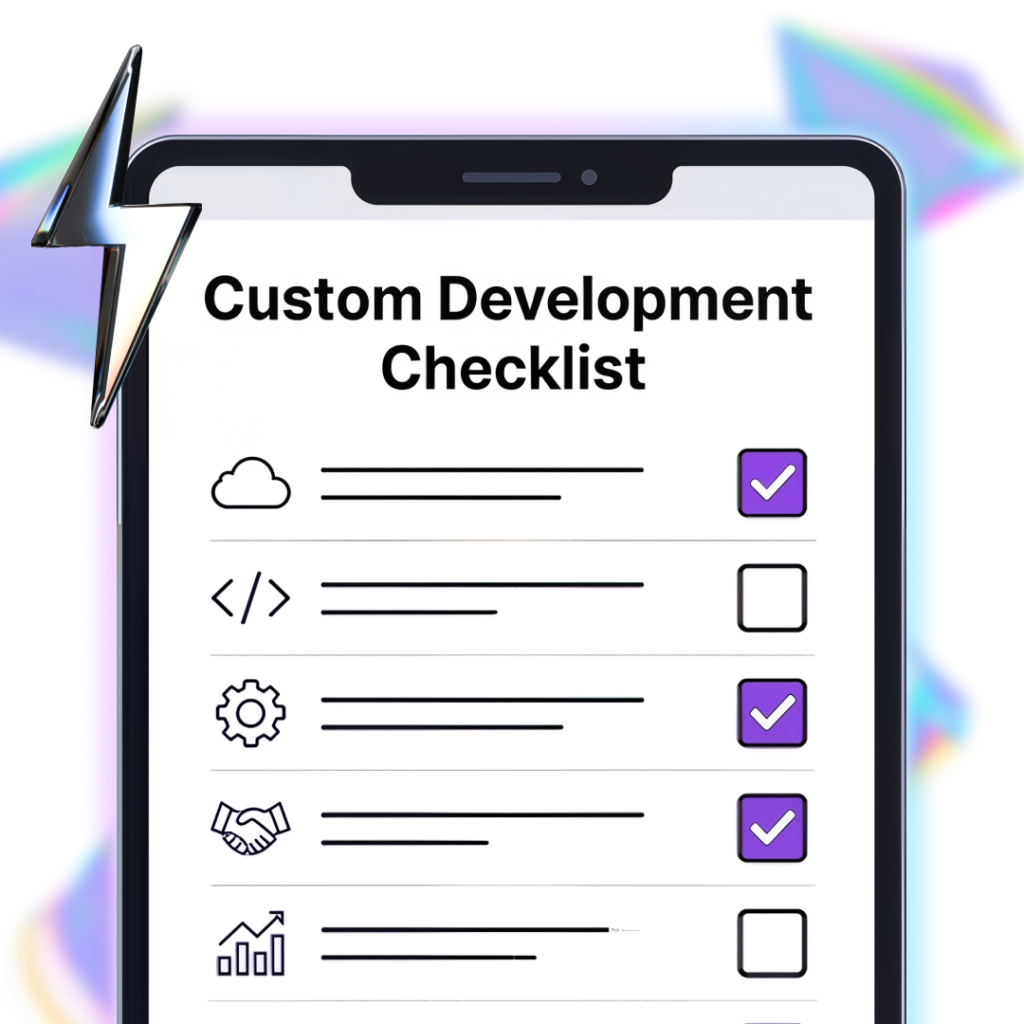
Below is a checklist for assessing the need for custom development. Please answer based on the actual current situation, not the desired one: each “yes” equals one point. The interpretation of the results will be covered in the next section.
If a company operates using relatively standard models—typical e-commerce, a service business with a standard sales cycle, or project management without industry-specific nuances—off-the-shelf solutions will work well. However, if there is non-standard logic involved—complex pricing rules, specific document workflows, multi-level approval processes, or industry requirements not covered by any template—each customization of a ready-made product to fit this specificity costs time and money. At some point, the total cost of these adaptations exceeds the cost of building a system from scratch tailored to real processes.
A practical test: if during a platform demo the team keeps coming back to the idea that a certain function will need to be handled manually or worked around—it’s worth pausing and counting how many such cases have already come up. One or two is fine. Five or more means the platform is not solving your problem.
Off-the-shelf platforms have limitations in terms of users, transactions, data volume, or functionality at a given pricing tier. Sometimes these limits are not critical; sometimes they become a ceiling that blocks growth. The key question is whether the platform will still be sufficient in two or three years. Migrating from a ready-made solution to a custom one after the business has grown is always more expensive and painful than designing the right architecture from the start.
A separate case is geographic scaling. If a company plans to enter new markets with different languages, currencies, tax rules, or regulatory requirements, it’s important to check how well the platform supports multi-region operations. Not all off-the-shelf solutions handle this equally well.
For most businesses, the performance of SaaS solutions is more than sufficient. However, there are cases where it becomes a competitive factor: trading platforms where response delay affects conversion, real-time systems processing thousands of events per second, or applications working with large datasets requiring specific optimization. If performance is part of the product’s value proposition, the architecture should be designed accordingly, rather than adjusted to fit the limitations of a standard platform.
Modern off-the-shelf solutions come with extensive libraries of integrations with popular services. But if you need to connect non-standard internal systems—legacy ERP, industry-specific databases, specialized government registry APIs, or proprietary production systems—ready-made connectors are often unavailable. Integration via custom middleware or API wrappers is technically possible, but in some cases its cost can be comparable to full custom development designed from the start for these connections.
Another factor is reliability. Every integration via a third-party connector adds a potential point of failure. The more such points exist, the harder it becomes to maintain system stability and diagnose issues when something goes wrong.
In fintech, healthcare, legal services, and the public sector, data requirements are often incompatible with what standard SaaS platforms offer. Where data is physically stored, who has technical access to it, how encryption is implemented, and whether the system can be deployed on your own infrastructure—all of this matters. If compliance is part of a company’s operations, security must be addressed at the architectural level, rather than layered on top of someone else’s platform through settings.
It’s also important to consider audit scenarios: some regulators require full control over infrastructure and the ability to provide detailed logs. This is straightforward in custom-built systems and significantly more difficult in off-the-shelf solutions.
The cost of custom development varies significantly depending on complexity and team setup. As a rough guideline for the Ukrainian market in 2026: an MVP from 15,000$ to 45,000$, an in‑house CRM or ERP from 50,000$ to 100,000$, and a B2B SaaS platform from 80,000$ to 180,000$. If your actual budget is noticeably lower than these figures and your task is relatively standard, starting with an off‑the‑shelf solution is usually more financially justified. Custom development with an insufficient budget almost always leads to technical debt and rework within a year.
Custom software requires ongoing technical support after launch: updating dependencies, fixing bugs, adapting to new operating systems and browser versions, and extending functionality. If your company does not have in‑house developers or a trusted external vendor for support, you must treat this as a mandatory cost line even before deciding on the approach.
A product without support does not fail immediately, but degrades systematically: first small bugs accumulate, then libraries become outdated, and eventually the system becomes incompatible with new platforms.
An off‑the‑shelf solution can often be configured and launched within weeks. For custom development, the minimum realistic timeframe from the start of Discovery to the first release is about three months; for more complex systems it can be six months or more. If the business has a hard deadline linked to seasonality, partnership commitments, or entering a new market, these timelines can become a decisive argument against going custom.
Annual costs for maintenance and updates typically amount to 15–25% of the initial development budget. A system built for 80,000$ means roughly 12,000$–20,000$ per year on support alone, without counting feature development. If this line is not built into the business model, it is often better to choose a solution with a predictable subscription where support is already included in the fee and there are no unexpected budget spikes.
The comparison between low‑code and custom is not always obvious at the start. A 500$‑per‑month subscription to a ready‑made platform may look cheaper than a 60,000$ custom build. But after three years the subscription totals 18,000$ and the company still owns nothing. A custom product, once it reaches break‑even, becomes your own asset. The ROI of custom development should be calculated over a 3–5 year horizon, taking into account not only subscriptions, but also costs of manual work, integrations, and workarounds that the off‑the‑shelf solution does not cover.
Another factor that rarely appears in initial calculations is the cost of migration. If the business is likely to move to a custom solution within a year or two anyway, the effort and expense of migrating data and processes from the off‑the‑shelf platform should be factored into the evaluation from the very beginning.
Complexity of the logic is one of the most reliable indicators of the need for custom development. If the system can be described with a few dozen rules, an off‑the‑shelf platform usually copes well. But if there are hundreds of conditions, multiple levels of roles and permissions, complex mathematical calculations, or non‑standard workflows, each new rule in a ready‑made solution often becomes a separate challenge: the platform either does not support it at all, or supports it through a workaround that breaks with the next update.
If the product needs to serve a large number of users or process significant volumes of data in real time, the right architecture must be planned from the start, not added later. Scaling an existing platform under extreme load is technically difficult: limitations are baked into the platform itself, and bypassing them without moving to a higher tier or replacing the system entirely is usually impossible. A custom architecture lets you scale exactly the components that are under the heaviest load.
Many off‑the‑shelf platforms offer responsive interfaces or basic mobile apps. But if you need a full‑fledged native app with offline mode, working with the camera or geolocation, push notifications, or deep integration with device hardware, this is a separate project. The most efficient approach is to build it within the same architecture as the main system, where the backend and the mobile client are designed together from the beginning, rather than being integrated later.
Ready‑made solutions are updated according to the vendor’s schedule. Sometimes this is convenient, as the platform handles security and compatibility automatically. But if the company has implemented substantial customizations, each major platform update can break the logic tailored to specific needs. A custom product gives full control over the roadmap: what to develop, in what order, and when, without dependency on a third‑party vendor’s priorities and commercial interests.
Dependency on a platform is a specific type of risk that is often overlooked at the start. A vendor can change its pricing policy, discontinue the product, withdraw support, or be acquired by a competitor. Own code is an asset of the company, protected regardless of what happens in the SaaS market. For businesses planning to raise investment or consider a potential sale, technological independence directly affects valuation.
There is also a practical side: when a company fully controls the codebase, it can switch vendors, bring in a new team, or adapt the tech stack without being tied to a single provider and its terms.
Your needs are fairly standard, and the market already offers proven tools to meet them. Focus on choosing the right platform and ensuring a high-quality implementation: even the best tool will yield poor results if it’s set up haphazardly or doesn’t align with your team’s actual processes. At this stage, the cost of a properly implemented off-the-shelf solution is consistently lower than the cost of custom development, and the risks are significantly lower.
If specific requirements arise in the future that don’t fit within the platform, it will become apparent. The key is not to try to solve a problem in advance that doesn’t yet exist.
You’re in a gray area where there’s no clear-cut answer, and that’s okay. A good strategy might be a hybrid approach: use a ready-made platform as a foundation and build specific functionality separately via an API or microservice. Or start with an MVP based on existing tools, collect real-world data from users, and make decisions about full-scale development based on concrete facts.
This approach reduces risks and allows you to test hypotheses before making major investments. If you’re in this situation, it’s worth seeking professional advice before making a decision: sometimes a single well-chosen tool solves the problem better than a complete development from scratch.
Your business has unique requirements that off-the-shelf solutions cannot meet without significant compromises. Investing in custom development is a sound choice in terms of product control, scalability, and long-term cost-effectiveness. The next step is the Discovery phase, which will allow you to accurately assess the scope and budget before development begins, without wasting resources on rework during the process.
It’s important to understand: a high score on the checklist doesn’t mean you need to develop everything at once. The smart approach is to start with the minimum necessary functionality that addresses the key task and develop the product through iterations. This reduces risk and maintains flexibility in decision-making.
Ukraine remains one of the most sought-after destinations for custom software development among European and American companies. The average hourly rate for Ukrainian developers ranges from $25 to $80, depending on their skill level and specialization, while teams from the U.S. or Western Europe charge between $90 and $200 per hour. With roughly the same level of technical expertise, this results in a significant difference in the final budget.