



February 2, 2026
The first written record of the term Business Intelligence dates back to 1865, when Richard Millar Devens described how banker Henry Furnese obtained market information ahead of his competitors and profited from it. This can be considered the earliest example of business intelligence, long before the advent of dashboards and SQL queries.
160 years have passed. The term has evolved, technologies have changed, but the confusion persists: five experts will give six different answers to the question of the difference between Business Intelligence and Business Analytics (in professional environments, these terms are most often used in Latin script). Both are about data, both help business, so it might seem like they are one and the same.
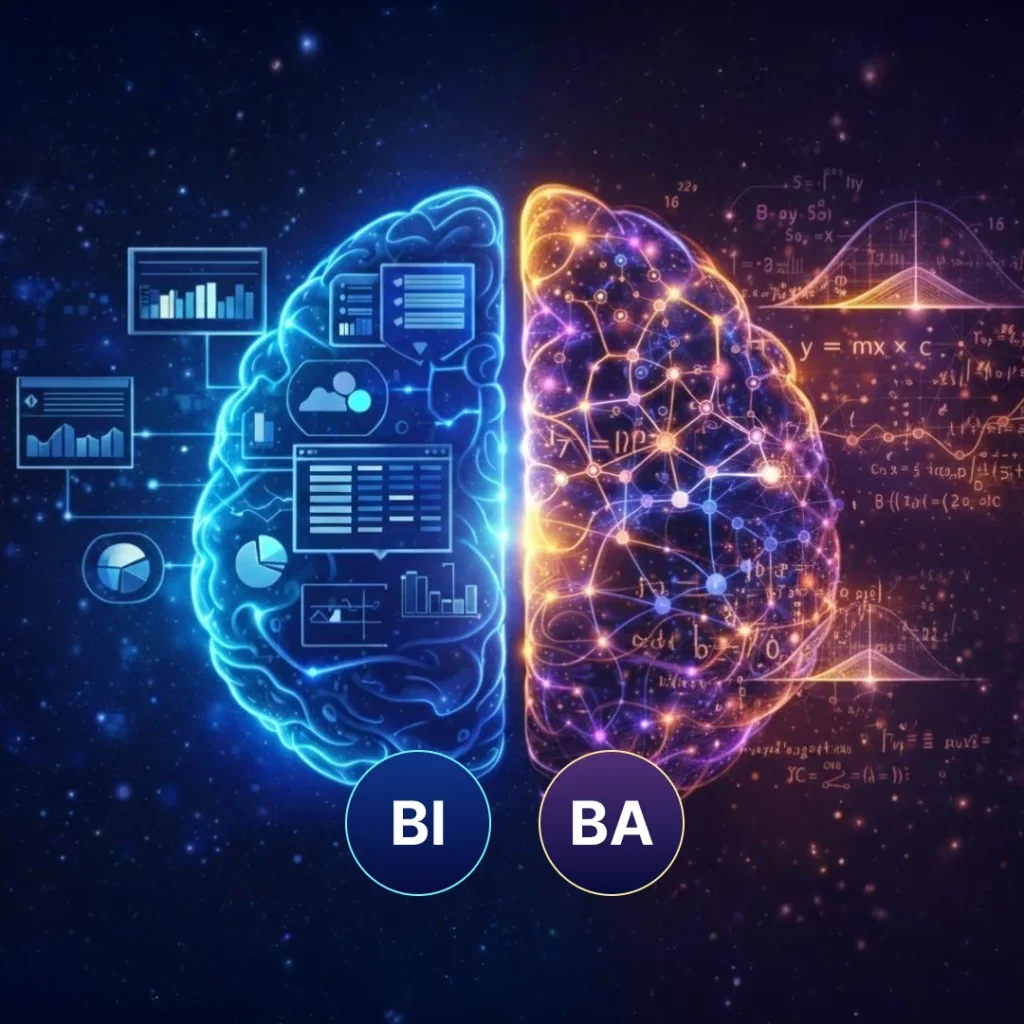
But that’s not the case. BI shows facts: how much was sold, how many customers came, where problems arose. BA seeks the reasons behind these facts and builds forecasts for the future. BI is like an X-ray of the business, while BA is a doctor’s diagnosis with a treatment plan. The difference is critical, especially when deciding where to invest the budget.
In this article, we’ll break it all down clearly: when BI is needed, when BA is, and why the strongest companies use both tools.
If you Google the difference between BI and BA, you’ll find many different explanations. Some say BI is for reports, BA for forecasts. Others say BI looks back, BA looks forward. And somewhere they even write that they are synonyms.
The most popular mistake is thinking BI and BA are the same thing, just different names.
This sounds logical until it comes to application. Because when BI builds a report for the CFO on past expenses, BA calculates exactly where the business will lose margin in the future and suggests changing the pricing model.
Second mistake: We already have analytics, so both BI and BA are present.
Having charts doesn’t mean the company makes data-driven decisions.
Third mistake: BI for managers, BA for analysts. Not at all, because managers use both tools, and analysts work with both too. It’s about the purpose.
Software vendors rarely stick to clear definitions: reporting platforms advertise themselves as analytical solutions, while forecasting tools are positioned as business intelligence systems. In practice, most modern systems combine functions from both areas.
Marketing names add to the confusion: data analytics, business analytics, predictive analytics, advanced analytics—each term sounds different, but the boundaries between them are blurred. One vendor calls forecasting business intelligence, another sells the same functionality as business analytics.
Consulting firms don’t simplify things either. They bundle BI and BA into one service, give it a general name, and sell it as a universal solution. The client pays for the project, but some tools turn out to be unnecessary.
So let’s move on and figure out what each one really is.
Before going deeper, here is the short answer. Business Intelligence (BI) is the discipline of turning historical business data into dashboards and reports that describe what already happened. Business Analytics (BA) goes further: it uses statistics and machine learning to explain why it happened and forecast what happens next.
If your question starts with ‘how much’ or ‘how many,’ you want BI. If it starts with ‘why’ or ‘what if,’ you want BA. BI is a rear-view mirror; BA is a GPS with a route prediction.
Business Intelligence is technologies, processes, and tools that transform raw data into understandable information. Imagine you have thousands of rows in Excel tables with sales from the past year. BI takes this data, structures it, and shows which region sold the most, which product flopped, when sales peaks were.
BI doesn’t invent anything new; it works with what has already happened. Its task is to provide a clear snapshot of reality so you can understand what’s happening in the business right now and what happened before.
BI answers three types of questions: what happened, when it happened, how many times it happened. Descriptive analytics is its main weapon.
You launch a dashboard and see: sales dropped 15% in the third quarter. Why did they drop? BI won’t tell you that. It will show numbers, charts, tables. It will break down the drop by regions, products, sales channels. But you’ll have to find the reason yourself.
Descriptive analytics works with historical data; it doesn’t try to predict the future. Its goal is to give the most accurate picture of what has already happened. It sounds simple, but this is where many companies waste budgets: they buy a BI system expecting a miracle and get reports. Which, by the way, are very useful if you know how to read them.
This process allows you to quickly get a complete picture of the business without manually processing each source.
The BI tools market is vast. Among the popular ones are Power BI (Microsoft integration, simplicity), Tableau (powerful visualization), Qlik Sense (associative data model), and Looker (flexible SQL-based control).
For small businesses, simpler options exist: Google Data Studio (now Looker Studio), Metabase, Redash. Fewer features, but sufficient to get started.
Retail: A supermarket chain analyzes sales; BI reveals which products flopped and which became hits. The manager sees rice sells twice as well in a specific region and increases procurement.
E-commerce: An online store spots in BI that 40% of customers abandon the payment page. They tweak the design, and conversion rates rise.
Business Analytics takes data further. While BI shows what happened, BA asks why it happened and what will come next. This is the next level of working with information.
BA employs statistical models, machine learning, and algorithms. It uncovers hidden patterns, builds forecasts, and tests hypotheses. Its goal is to answer complex questions, operating where answers aren’t obvious: digging deeper to find cause-and-effect relationships.
BA leverages two types of analytics: predictive and prescriptive.
Predictive analytics forecasts the future based on the past. Algorithms study historical data, identify patterns, and extrapolate them forward. How many customers will come next month? Which product will become a hit? Who will churn from the service?
Prescriptive analytics goes even further: it doesn’t just predict but suggests specific actions. If you do A, B will happen. Raise prices by 10%, sales will grow 15%. Send emails on Tuesdays for 8% higher open rates.
The difference is critical. BI displays a dashboard with sales drops, while BA builds a model explaining the drop ties to seasonality, competitor pricing, and audience behavior shifts. It then offers three action scenarios with forecasted outcomes for each.
BA tackles questions without obvious answers. The analyst formulates a hypothesis, gathers data, selects a method—regression, clustering, ML—builds a model, validates its accuracy, and explains results to the business.
Unlike BI, which shows facts, BA uncovers causes and proposes solutions. If the model proves accurate, it’s integrated into processes: systems auto-personalize prices or predict risks.
Tools are selected depending on the task and the team.
An insurance company forecasts risks. The BA model analyzes hundreds of client parameters—age, profession, claims history, location—and calculates the probability of an insurance event. Based on this, it sets personalized policy prices: low-risk clients pay less, high-risk ones pay more.
A retailer personalizes recommendations. BA examines a user’s purchases, compares them to similar customers’ behavior, and builds a taste profile. When the customer visits the site, they see not random products but ones tailored specifically for them—conversion rates increase.
BA creates systems that make decisions autonomously or guide people toward them.
BI looks backward, relying on historical data: last month, last quarter, last year. The more history, the better BI understands trends. Dashboards show dynamics over the past 12 months, compare this year to last, and spot seasonal fluctuations.
BA looks forward. History is needed only as a foundation for forecasts: algorithms study the past to predict the future. Next quarter, next year, long-term trends. BA builds scenarios: what happens if the market grows 10%, if competitors cut prices, if regulations change.
The time horizon dictates the tools. BI works with fixed periods: this week, this month. BA deals with probabilities: with 75% accuracy, sales will rise 12-18% next quarter.
Example: BI records that demand for a product dropped in Q2. BA shows it’s linked to new EU regulations and currency shifts, forecasting a further 12% profit drop next quarter without changes.
For example, a pharmaceutical company uses BI to track drug sales dynamics across different regions. BA, however, helps identify which external factors (disease seasonality, weather conditions, or competitors’ campaigns) influence demand. Based on the forecast, the company adjusts logistics and marketing, avoiding shortages and overruns.
BI loves stability: set up the dashboard once, and it works for months. Metrics are clear: revenue, customers, conversion, average check. Data is taken from CRM, ERP, sales databases. Everything is structured, all in tables. The system generates reports automatically at set intervals.
BA works differently, and every project is research from scratch. The analyst formulates a hypothesis, collects data to test it, experiments with methods. Today regression, tomorrow clustering, next week time series forecasting. Data sources are diverse: customer reviews (analyzed via text processing), product images (computer vision), social media, weather, economic indices.
Key difference: BI automates routine, BA requires expertise at every step. The model can run automatically, but only a human can build it.
BI analyst is a semi-technical role. SQL is needed to extract data, knowledge of BI platforms like Power BI or Tableau, understanding of business processes. The main skill is turning numbers into understandable stories for managers, programming is not mandatory. A BI analyst can move to more complex tasks after a few months of training, depending on the base.
BA analyst is a technical role with a mathematical bias. Statistics, probability theory, programming in Python or R are mandatory. The analyst builds ML models, tests hypotheses, interprets results for business. 1-2 years of training are needed, better with a specialized education in mathematics or data science.
Salaries differ too. In the US, the average BI analyst salary is $95,000-$99,000 per year as of 2026. Business Analyst (a role close to BA) earns $88,000-$106,000. Data Scientist (the deepest BA level with ML expertise) – $122,000-$153,000.
BI works with Power BI, Tableau, Qlik or Looker for visualization. SQL Server, PostgreSQL, MySQL for databases. Talend or Fivetran for ETL processes. Snowflake, Redshift or BigQuery as data warehouses. And yes, Excel remains one of the main tools for many BI analysts.
BA requires Python or R for coding. Jupyter Notebook for experiments. AWS SageMaker or Azure ML for model training. Spark or Databricks for big data. Git for code version control.
There is overlap: both sides use SQL and the same data warehouses. But BI stops at extraction and visualization, BA goes further to modeling.
Implementation speed differs. BI can be launched in a week: connect sources, create dashboards, set up access. A BA project takes months: data collection, feature preparation, model training, testing, integration.
| Aspect | Business Intelligence (BI) | Business Analytics (BA) |
| Focus | Descriptive – what happened | Predictive/prescriptive – why & what’s next |
| Core question | How much? How many? When? | Why? What if? What’s optimal? |
| Data approach | Structured, reporting-driven | Exploratory, model-driven |
| Typical skills | SQL, BI platforms, business context | Statistics, Python/R, machine learning |
| Typical tools | Power BI, Tableau, Looker | Python, R, SageMaker, Databricks |
| Time to first result | 1-2 weeks | Weeks to months |
| Typical budget (SMB) | $10K-$30K/year | $50K-$200K+ depending on complexity |
Short answer: not quite, and the difference between business intelligence and business analytics comes down to scope. ‘Analytics’ is an umbrella term that covers everything from a simple pivot table to a deep-learning model – Business Intelligence is one specific, reporting-focused branch of it. So business intelligence vs analytics is really a whole-vs-part comparison, not two competing tools.
The more precise comparison is BI vs data analytics: data analytics is a broader technical field that includes business use cases but also scientific, engineering, and research use cases with no business decision attached at all. Business Intelligence, by contrast, exists specifically to support business decisions – every dashboard, every KPI, every report has a business owner and a business question behind it.
Operational reporting is needed: Track sales daily, analyze website traffic weekly, reconcile budget vs. actual monthly. BI excels at routine metric monitoring.
Clear KPIs exist: Conversion, average order value, order processing time, warehouse utilization. When metrics are known and stable, BI automates tracking.
Quick problem detection is required. E.g., sales drop 20% in a week. BI flags it instantly, breaks it down by regions/products; managers spot red zones and react.
Team is non-technical: Sales managers, marketers, financiers. BI offers self-service tools—click, filter, view results.
Budget is limited: BI platforms are cheaper than BA infrastructure. Accessible even for small businesses.
Data is structured: If everything’s in databases/CRM, BI connects fast and works. No need to clean unstructured data or build complex pipelines.
Historical perspective matters: Compare this year to last, spot 3-year trends, understand seasonality. BI does this automatically.
Example: A retail chain opens a dashboard every morning to see yesterday’s sales across stores, inventory levels, top-10 products. Leadership grasps the situation in 5 minutes and plans the day.
Root causes need understanding: Why customers go to competitors, what factors influence decisions.
Future needs predicting: Expected orders next month, which products will hit, who’s most likely to buy premium? BA builds models for answers.
Decisions are high-stakes: New product launch, market entry, big marketing investments. When risks are high, BA forecasts scenario outcomes.
Data is complex/diverse: Transactions, reviews, social media, weather, exchange rates—all impact business; BA integrates into unified models.
Personalization is key: Product recommendations per user, tailored discounts, dynamic pricing. BA crafts algorithms for individual treatment at scale.
Technical team exists: Data scientists, ML engineers, coding-savvy analysts. BA demands expertise beyond drag-and-drop tools.
Competitive edge is critical: When all use BI for basics, BA provides leverage. 10% better demand forecasting saves millions for large firms.
Example: An insurer wants to cut fraud; BI flags 5% suspicious claims. BA’s ML model analyzes thousands of claim parameters to spot fraudsters. Per company experience, ML detection hits 80-85% accuracy (task/data-dependent).
Top companies don’t choose between BI and BA—they use BI as foundation (data collection, reporting, current monitoring), then layer BA for depth: why metrics shift, what’s next, how to optimize.
They complement naturally: BI spots sales anomaly, BA explains why. BA forecasts demand, BI tracks accuracy daily. Data collected once, used by both. Managers check BI dashboards for daily calls; execs get BA forecasts for strategy.
Example: E-commerce uses BI for sales/traffic monitoring. BA predicts weekly buyers; system auto-sends personalized offers. Conversion rises 35%, ad spend drops 20%.
Overall advice: Start with BI, add BA as business grows.
Analytics maturity evolves in stages.
Level 1: Chaos. Data scattered. Departments keep silos, reports manual. Decisions gut-based.
Level 2: Basic Reporting. First BI tool appears. Data centralized, standard dashboards for key metrics. Managers see reality, but analytics reactive.
Level 3: Integrated BI. All systems feed unified warehouse; reports auto-update. Users self-build simple analyses sans IT; decisions fact-based.
Level 4: Predictive Analytics. BA joins. Initial ML forecasts demand, churn, risks. Forward-looking, but models non-embedded: ad-hoc studies.
Level 5: Prescriptive Analytics. BA fully integrated. Algorithms auto-decide: prices, offers, routes. System recommends actions.
Most firms at 2-3. Levels 4-5 need tech/team investment but yield edge.
Implementing integrated BI/BA strategy is comprehensive, often needing business consulting experts. Key components:
Unified data warehouse. All data centralized; BI/BA read from it. Ensures consistent numbers.
Shared governance. Who owns data quality? Metric definitions? Confidentiality? Uniform rules prevent chaos.
Result integration. BA forecasts feed BI dashboards: sales forecast beside actuals, churn risk in CRM. Algo recs where decisions happen.
Automated cycle. Data flows in, cleans, stores; BI analyzes, BA models, results loop back. Hourly/real-time updates.
Continuous improvement. BA predicts, BI tracks actuals. Gaps analyzed, models refined—system sharpens over time.
Tech matters, but people drive it.
Structure counts. Central team sets standards (detached from business) vs. embedded per dept (business-savvy but siloed). Hybrid wins: center enforces, embeds solve daily pains.
Roles differ, goal unified. BI builds dashboards/data quality; BA hunts patterns/forecasts. Data Engineer keeps pipes flowing. Anomaly? BI taps BA. Knowledge flows via shared code/docs/weekly syncs.
Flexibility retains talent. BI learns Python → BA. BA eyes infra → engineering. Internal growth preserves expertise.
What kills analytics: Isolated BI/BA—no comms, divergent data/sources/conclusions. Unified team with specialties thrives; silos fail.
Before investing, answer honestly.
Current data state? Scattered in sheets/CRM/email? BI first: centralize, basic reports. Already warehoused/dashboards? Consider BA.
Key questions? List top 10. Mostly past/present? BI. Future/optimization? BA.
Budget? Small biz BI: $10K-$30K/year. BA ML build: $50K-$200K+ by complexity. Solid BI > half-baked BA.
Tech team? BI needs 1-2 SQL/PowerBI analysts. BA demands math/coding data scientists.
Timeline? BI: 1-2 months to dashboards. BA: months for build/test/integrate.
Small biz maximizes lean impact.
Inventory data: Pinpoint critical (sales/customers/finance). Pick key sources.
Simple tool: Skip enterprise bloat. Build 3-5 dashboards for pains; don’t boil ocean.
Automate intake: Zapier/Make links systems; no manual copies.
Train team: Workshop on reading dashboards—or it gathers dust.
Skip early BA. Master data control first.
Mid-size (50-500) outgrows Sheets/basic dashboards; infra must scale.
Invest in warehouse: Central hub essential for growth.
Team ramp: Start BI analysts + Data Engineer. Solid basics → add Data Scientist for forecasts. Defer complex ML.
Standards: Metric glossary—“active user” means same everywhere.
Manager autonomy: Self-simple analyses frees analysts for depth.
Prove ROI: Metrics justify budget to leadership.
Sequence: Infra → basic analytics → predictions.
Enterprises (500+) embed analytics in core business.
Analytics powers product/decisions under Head of Data: analysts/engineers/AI pros. Environment where biz sees/understands/acts on data.
Infra: warehouse, auto-processing, forecast models, governance. Data flows source-to-decision sans hands.
Data control critical: access, sourcing, PII (regs in finance/healthcare = liability).
Proactive: constant hypothesis tests/process opts/growth hunts. Analytics is at the center of decision-making.
Huge investments, but uncopyable edge.
Biggest threat: Bureaucracy slows speed—data burdens, not empowers.
In Lieu of a Conclusion
Most need both. Start BI for foundation. With data tamed/team data-fluent, layer BA. No skipping stages—analytics is marathon.
Every biz unique: size/industry/culture/resources shape choice. Unsure? One used dashboard > ten dusty models.
BI/BA turn data to decisions. Haven’t started? Now’s time. Need implementation help? Our consultants guide strategy at free workshop.
Traditional BI shows a human a dashboard and waits for that person to interpret it and decide. AI – specifically machine learning models – can go a step further and act on data directly: flagging fraud, adjusting a price, or triggering a workflow without a human in the loop. The line is blurring fast, though: most major BI platforms now embed AI features (natural-language query, auto-generated insights, Copilot-style assistants), so ‘BI vs AI’ increasingly means ‘BI with AI built in’ rather than a strict either/or.
Big data isn’t a decision-making discipline at all – it’s a description of the data itself: high volume, high variety, high velocity, often unstructured (logs, sensor feeds, social media). BI is one of several ways to make sense of that data once it’s been processed; without a BI (or BA) layer on top, big data is just a very large, very expensive pile of files.
Predictive analytics is best understood as a specific technique inside the BA toolbox, not a rival to BI. BI answers ‘what happened,’ predictive analytics answers ‘what’s likely to happen next’ using statistical models trained on that same historical data. A mature analytics setup typically uses BI to monitor the present and predictive analytics to prepare for what’s coming.
Embedded analytics vs business intelligence isn’t really a contest between two different disciplines – it’s a difference in delivery method. Instead of opening a separate BI tool like Power BI or Tableau, the user sees charts and metrics built directly into the software they already use: a sales dashboard inside the CRM, or usage stats inside a SaaS product’s own admin panel. For end customers and internal teams alike, embedded analytics removes a login and a context switch, at the cost of some of the flexibility a dedicated BI platform offers.